
20 Nov 2026
Clascoterone for hair growth: evidence, safety, and availability
Review the latest evidence on clascoterone for hair growth, including Phase 3 results, safety limits, Breezula availability, and treatment context.
Share


TL;DR
Clascoterone for hair growth is a topical androgen-receptor blocker being developed for male androgenetic alopecia. Company-reported Phase 3 findings are promising, but full peer-reviewed data are needed to judge the visible benefit, long-term safety and performance against established treatments. Breezula 5% scalp solution and Winlevi 1% acne cream are different formulations and should not be treated as interchangeable.
Table of Contents
- Clascoterone for hair growth: what it is and why it matters
- Breezula versus Winlevi: the 5% solution is not the 1% acne cream
- How clascoterone differs from finasteride, dutasteride, and minoxidil
- Clascoterone hair-loss results: what the trials actually found
- Safety: topical does not mean side-effect-free
- Who may or may not match the clinical-trial population?
- Approval, availability, and buying clascoterone safely
- Realistic expectations: timeline, maintenance, and before-and-after photos
- Where clascoterone may fit in a personalized hair-loss plan
- FAQ
- Build an evidence-based hair-loss plan
Clascoterone for hair growth: what it is and why it matters
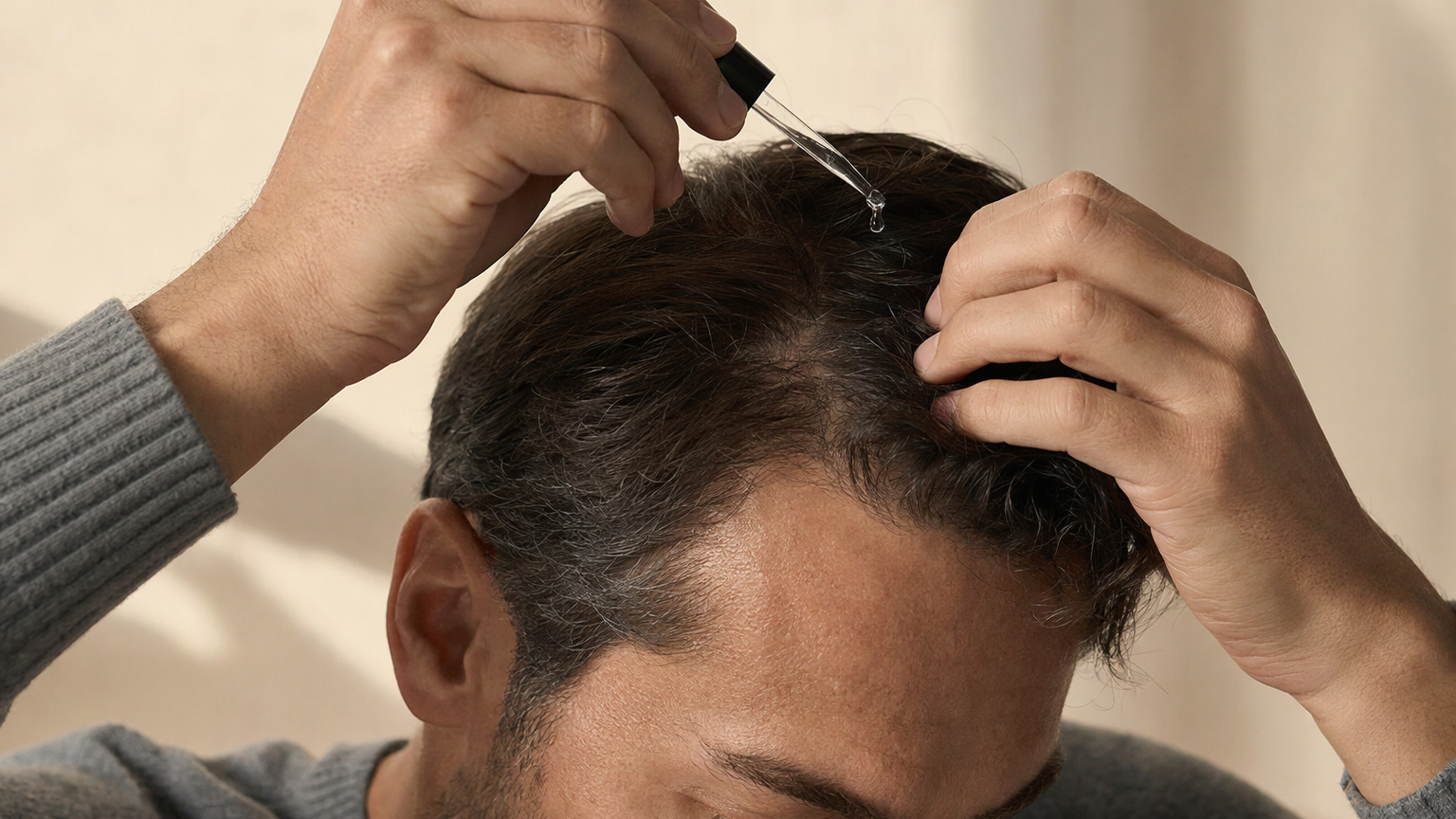
Clascoterone is a topical androgen-receptor antagonist being studied for androgenetic alopecia, or pattern hair loss. It is intended to interfere with androgen signaling at scalp follicles rather than reduce DHT production throughout the body.
That local mechanism may appeal to people concerned about oral medication. However, “topical” does not mean risk-free, and positive trials do not establish dramatic regrowth, long-term safety or superiority to finasteride or minoxidil.
The evidence discussed here concerns pattern hair loss. Alopecia areata, telogen effluvium and scarring alopecia have different causes and require different care.
What is Breezula 5% solution used for?
Breezula is the name associated with the investigational clascoterone 5% solution studied for male androgenetic alopecia. Its intended role is to block androgen-receptor signaling around susceptible follicles.
A studied use is not necessarily an approved use. The supplied sources report Phase 3 investigation and positive company findings, but they do not independently confirm marketing authorization for hair loss.
Why androgenetic alopecia is the target
In genetically susceptible follicles, androgen signaling contributes to progressive miniaturization. Hair shafts become finer, and scalp coverage may decline.
Family history can support a diagnosis, but it cannot predict an individual response to clascoterone. Pattern, severity and previous treatment response also matter.
Breezula versus Winlevi: the 5% solution is not the 1% acne cream
Clascoterone is the active ingredient in both products, but the finished formulations and intended uses differ.
| Feature | Breezula | Winlevi |
|---|---|---|
| Formulation | 5% scalp solution | 1% cream |
| Studied use | Male androgenetic alopecia | Acne vulgaris |
| Evidence base | Hair-loss trials | Acne trials |
| Status in supplied sources | Investigational for hair loss | FDA-approved for acne in patients aged 12 and older |
Sharing an ingredient does not establish equal delivery, stability, safety or effectiveness.
Why concentration and vehicle change performance
The vehicle affects how a topical product spreads, remains stable and reaches the treatment area. Concentration, application amount and frequency also determine exposure.
Using clascoterone acne cream on the scalp is therefore not equivalent to using the investigated 5% solution.
Can Winlevi be applied to the scalp for hair loss?
Winlevi’s acne approval does not establish that it is approved or effective for scalp hair loss. We do not recommend treating it as a do-it-yourself Breezula substitute.
A clinician should first confirm the cause of the hair loss and review regulated, evidence-based options.
How clascoterone differs from finasteride, dutasteride, and minoxidil

These treatments act through different mechanisms:
| Treatment | Main mechanism |
|---|---|
| Clascoterone | Blocks androgen signaling at the receptor |
| Finasteride | Reduces DHT production through 5-alpha-reductase inhibition |
| Dutasteride | Inhibits both major forms of 5-alpha-reductase |
| Minoxidil | Supports growth through a non-androgen pathway |
Clascoterone should not yet be described as a proven finasteride replacement. Our dutasteride-versus-finasteride comparison explains how established DHT-lowering options differ.
Does clascoterone lower DHT?
Not through its intended primary mechanism. It is designed to compete at androgen receptors rather than inhibit the enzymes that produce DHT.
A local mechanism may limit systemic exposure, but it does not prove zero systemic activity.
Could it replace or complement minoxidil?
Clascoterone targets androgen signaling, while minoxidil works through another pathway. Combining them may be scientifically plausible, but a specific regimen still needs evidence for safety, dosing and effectiveness.
We would not stop an existing treatment solely because of early Breezula results.
Clascoterone hair-loss results: what the trials actually found
Cosmo Pharmaceuticals reported results from SCALP 1 and SCALP 2, two Phase 3 trials involving a combined 1,465 men in the United States and Europe. Both reportedly met their primary endpoint for target-area hair count compared with vehicle.
SCALP 1 showed a reported 539% relative improvement over vehicle, while SCALP 2 showed 168%. The company described adverse-event rates as comparable with vehicle and generally unrelated to treatment.
These are relative figures from manufacturer-reported topline results. The supplied coverage does not provide the absolute hair-count changes needed to judge the practical size of the benefit. We review the distinction in our clascoterone trial, safety and FDA-status update.
How much hair did participants gain?
The supplied reports do not give verified absolute changes for each treatment and vehicle group. They therefore cannot support a precise claim about hairs gained per square centimetre.
Target-area counts are standardized research measurements, not a promise of equivalent regrowth across the scalp.
What do large relative percentages mean in the mirror?
A large relative difference can result from a modest active-treatment change compared with little improvement—or a decline—in the vehicle group. Relative percentages alone do not show whether the result was cosmetically dramatic.
We separate four questions: Was the result statistically significant? What was the absolute change? Was it visible? Did participants consider it worthwhile?
Have the findings been peer reviewed?
The pivotal findings in the supplied material were reported as company topline results rather than complete peer-reviewed Phase 3 papers.
A full assessment requires absolute results, protocol details, discontinuation data, subgroup analyses and longer-term safety and efficacy findings.
Safety: topical does not mean side-effect-free
The manufacturer reported adverse events comparable with vehicle, but the supplied reports do not give detailed rates for individual reactions, serious events or discontinuations.
Before any treatment, we recommend pre-treatment risk screening rather than assuming a topical drug is harmless.
Local scalp effects and tolerability
Application-site problems may include irritation, redness, itching or dryness, although the supplied Phase 3 coverage does not provide verified rates. Vehicle-group results matter because the inactive formulation can also irritate the scalp.
Winlevi’s acne tolerability cannot automatically be applied to a different concentration, vehicle, treatment area and duration.
Systemic exposure and hormone-related questions
The manufacturer describes clascoterone as acting locally without systemic absorption. Detailed pharmacokinetic and endocrine results were not included in the supplied reports, so we would not translate that statement into “zero systemic risk.”
Long-term use, broader patient groups, pregnancy exposure and drug interactions require appropriate evidence.
Will clascoterone cause initial shedding?
The supplied reports do not establish a characteristic early-shedding pattern. Experiences associated with minoxidil should not automatically be attributed to clascoterone.
Sudden, severe, patchy or inflamed hair loss needs clinical assessment.
Who may or may not match the clinical-trial population?
The pivotal program included men with androgenetic alopecia in the United States and Europe. The supplied coverage does not provide enough detail to reproduce all age, severity and eligibility criteria.
The results should not automatically be generalized to women, adolescents or people with unexplained shedding.
Does clascoterone treat alopecia areata?
The supplied evidence does not establish clascoterone as a treatment for alopecia areata. That condition is autoimmune, while clascoterone’s investigated role concerns androgen signaling in pattern hair loss.
What about women with pattern hair loss?
A local androgen-receptor treatment may be relevant in theory, but the pivotal results described here concern men. Evidence for women requires dedicated efficacy and safety data, including reproductive-safety considerations.
Why diagnosis comes before personalization
Pattern hair loss can resemble or coexist with telogen effluvium, medication-related loss, nutritional problems and inflammatory or scarring conditions.
For us, personalization means confirming the diagnosis, choosing an appropriate mechanism and tracking the response—not claiming that one genetic marker predicts everything.
Approval, availability, and buying clascoterone safely
Regulatory status — last assessed October 20, 2026
The supplied sources establish Phase 3 investigation of clascoterone 5% solution for male androgenetic alopecia. They do not independently establish hair-loss authorization or a commercial launch date for Breezula.
Regulatory status must be checked in current FDA, EMA, European Commission, MHRA or relevant national databases. Positive trials, an application, approval and commercial launch are separate milestones.
Regulatory status — last verified on the article publication date
Winlevi’s acne approval does not establish approval of Breezula for hair loss. If current authorization cannot be confirmed through a regulator, the accurate answer is “not confirmed.”
Compounded products are not automatically equivalent to the formulation used in Phase 3 trials.
Why an online product page cannot prove authenticity
A product page, label or testimonial cannot verify ingredient identity, concentration, stability, manufacturing quality or lawful dispensing. It also cannot show whether a product matches the trial formulation.
Before-and-after images cannot reveal diagnosis, adherence or concurrent treatments.
A four-part verification standard
Before considering any clascoterone product, we would verify:
- The diagnosis with a qualified clinician.
- Authorization and prescription requirements.
- The concentration, vehicle, source and storage conditions.
- Whether the evidence applies to that finished product.
Realistic expectations: timeline, maintenance, and before-and-after photos
The available reports discuss results after six months of treatment. Hair outcomes are better assessed through planned comparisons than daily mirror checks.
When might someone notice a change?
Biological activity, measured hair-count changes and visible improvement are different milestones. The evidence does not support a guaranteed week-by-week timeline.
Standardized baseline and follow-up measurements provide a more reliable assessment.
Would the results require ongoing treatment?
Pattern hair loss remains biologically active, so effective medical treatments commonly require maintenance. The persistence of clascoterone’s effects after discontinuation needs dedicated follow-up data.
How to judge before-and-after evidence
Useful photographs should control lighting, angle, camera distance, hair length, styling and wetness. Concurrent medications, procedures and concealers must also be recorded.
Social-media reports can raise useful questions, but they cannot confirm diagnosis, product authenticity or causation.
Where clascoterone may fit in a personalized hair-loss plan
Clascoterone may eventually provide another scalp-directed way to address androgen signaling. Its role will depend on authorization, complete clinical evidence, tolerability and individual priorities.
Questions to discuss with a qualified clinician
We suggest asking whether the diagnosis supports androgenetic alopecia, how closely the patient matches the trial population and whether the exact studied formulation is authorized. A plan should also define baseline measurements, side-effect monitoring and reassessment dates.
The bottom line on clascoterone for hair growth
Clascoterone is a credible investigational treatment with encouraging company-reported Phase 3 results. It is not yet reasonable to claim guaranteed visible regrowth, proven superiority or established long-term safety from the supplied evidence.
FAQ
What are some new treatments for hair loss?
Clascoterone is one investigational approach for androgenetic alopecia. We recommend judging any new treatment by its mechanism, study population, absolute results, safety evidence and regulatory status—not by headlines alone.
What is Breezula 5% solution used for?
It has been studied as a topical treatment for male androgenetic alopecia. Its intended action is to block androgen signaling at scalp-follicle receptors. Current authorization should be confirmed with the relevant regulator.
What are the differences between clascoterone and finasteride?
Clascoterone blocks androgen receptors locally, while finasteride reduces DHT production by inhibiting 5-alpha-reductase. Direct comparative evidence is needed before clascoterone can be called a replacement.
What is the best cream for treating alopecia areata?
There is no universally best cream, and clascoterone is not established for alopecia areata. Treatment depends on the patient’s age, disease extent, duration and medical history.
Build an evidence-based hair-loss plan
Explore personalized genetic hair-loss care from roots by Genetic Arts to assess likely drivers, compare appropriate options and track results through a structured treatment plan.
Roots by Genetic Arts
20 Nov 2026
Thanks for your order!
Login into your profile to set up your account.