
4 Nov 2026
Clascoterone Hair Loss Headlines Decoded: What SCALP Phase 3 Really Shows
Understand what SCALP Phase 3 reveals about efficacy, safety, FDA status and evidence gaps. Explore what Breezula’s results could mean for patients.
Share


TL;DR
Reported Phase 3 results make clascoterone hair loss treatment promising for men with mild-to-moderate androgenetic alopecia. They do not establish that Breezula is FDA approved, commercially available or suitable for every type of hair loss. Before drawing firmer conclusions, we need full trial data showing absolute hair-count differences, confidence intervals, patient-reported outcomes and complete safety results.
Table of Contents
- Clascoterone SCALP Phase 3 results: the careful verdict
- What SCALP-1 and SCALP-2 tested
- What target area hair count leaves out
- Did SCALP-1 and SCALP-2 tell the same story?
- Patient-reported growth: significant versus noticeable
- Topline results, peer review and FDA review are different stages
- Who these results apply to
- What a planned US filing means
- FAQ
- Get answers based on your biology
Clascoterone SCALP Phase 3 results: the careful verdict
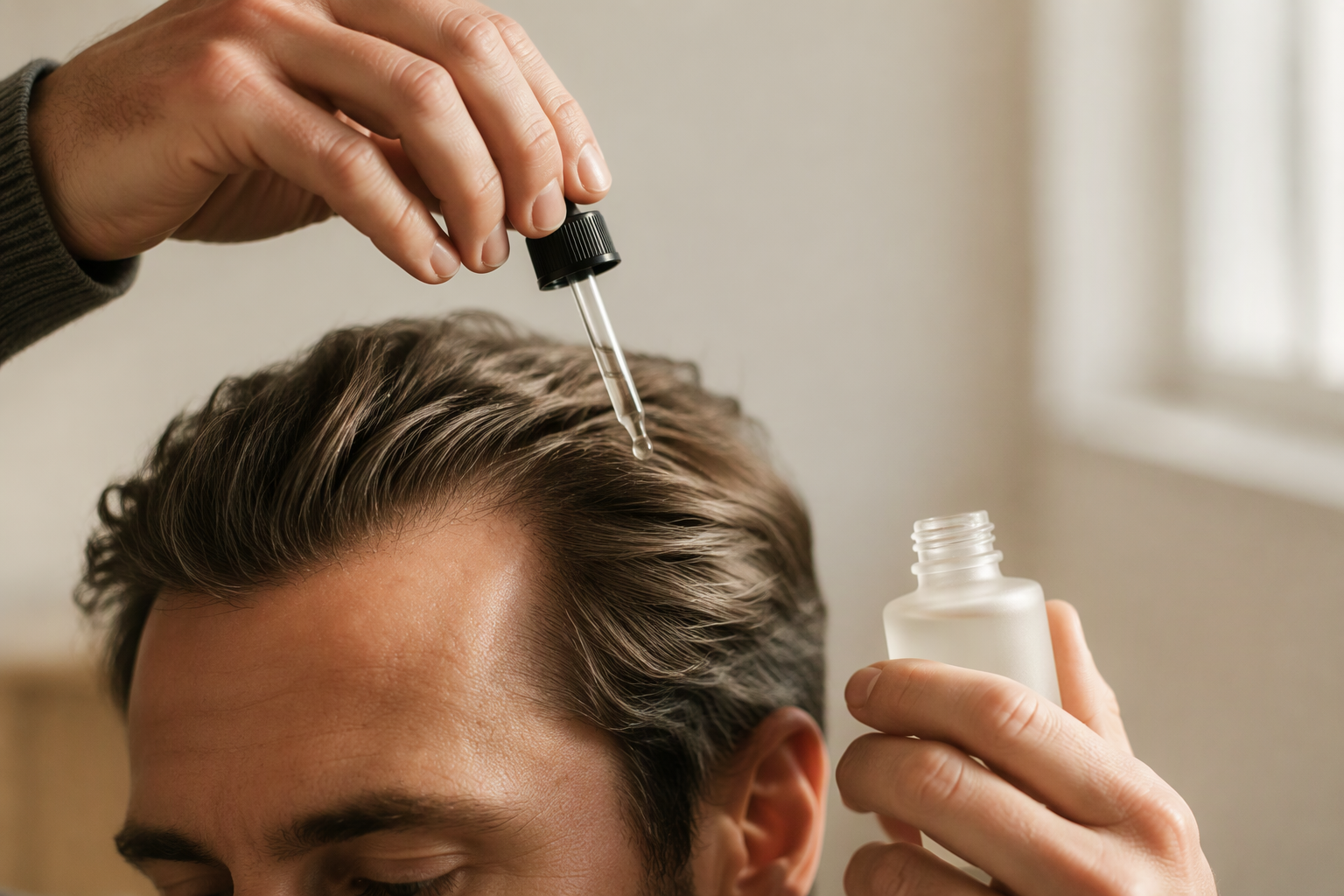
SCALP-1 and SCALP-2 were reported as positive pivotal trials. That supports cautious optimism about clascoterone for the population studied: men with mild-to-moderate androgenetic alopecia.
“Successful,” “proven” and “FDA approved” are not interchangeable. Current efficacy claims rely largely on sponsor-announced results and related coverage, not complete peer-reviewed Phase 3 publications or an FDA assessment.
Current status
- Phase 3: Positive results have been reported
- Studied condition: Male androgenetic alopecia
- US status: Not FDA approved for hair loss
- Availability: A planned filing does not guarantee approval or launch
For mechanism, safety and availability background, see our broader clascoterone hair loss evidence guide. Here, we focus on what the SCALP reports establish—and what remains uncertain.
What SCALP-1 and SCALP-2 tested
Public reporting describes vehicle-controlled studies of clascoterone 5% topical solution in men with mild-to-moderate androgenetic alopecia. An April 2026 HCPLive report said the Phase 3 program recruited 1,465 participants across 51 sites in the US and Europe, with results reported through 12 months.
| Design feature | Reported information |
|---|---|
| Population | Men with mild-to-moderate androgenetic alopecia |
| Investigational treatment | Clascoterone 5% topical solution |
| Comparator | Vehicle |
| Objective measure | Target area hair count |
| Program size | 1,465 participants across 51 sites |
| Follow-up reported | 12 months |
| Full protocol and analysis plan | Not established by the supplied material |
We should not merge two trials into one result simply because their designs were related. Trial-specific enrollment, baseline characteristics, endpoint definitions and missing-data methods must be reviewed separately when complete reports become available.
The trial population and regimen
The findings concern a selected group of men with mild-to-moderate patterned hair loss. They cannot automatically be extended to women, advanced baldness, alopecia areata, scarring alopecia or acute shedding.
The investigational product was a 5% scalp solution. It was not a tablet or improvised scalp use of a clascoterone acne cream.
Endpoints and analysis populations
Target area hair count was a central efficacy measure. However, the supplied sources do not fully establish the endpoint hierarchy, exact measurement area or all patient- and investigator-rated assessments.
They also do not provide enough detail about analysis populations, discontinuations or missing-data assumptions. Those choices affect how confidently we can interpret a treatment effect.
What target area hair count leaves out
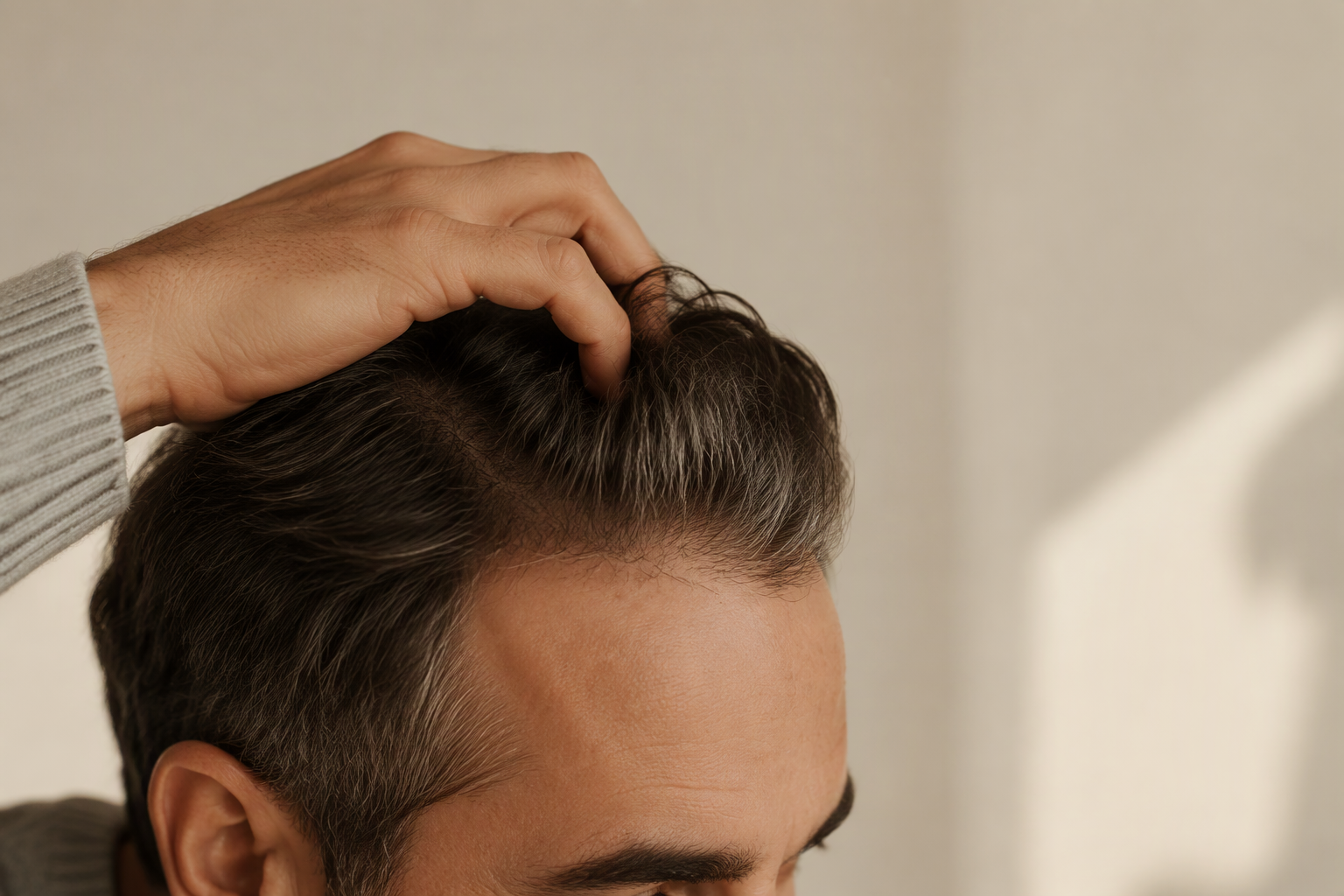
Target area hair count measures qualifying hairs within a predefined scalp area. It does not represent the number of new hairs across the whole scalp.
A complete report should include:
- Baseline and follow-up counts for both groups
- Absolute changes and between-group differences
- Confidence intervals
- The measured area’s dimensions and location
- Imaging and counting methods
- Patient- and investigator-rated improvement
The available sources do not provide enough trial-level figures for us to reproduce headline comparisons reliably. We would not convert them into claims about whole-scalp growth or guaranteed cosmetic improvement.
Absolute versus relative improvement
Relative percentages depend on the comparison point. A result may sound dramatic when expressed relatively even if the absolute difference is modest.
The practical question is not just, “What percentage improvement was reported?” We also need to ask, “How many additional hairs were counted, over what area and with what statistical uncertainty?”
Does a higher count mean visibly fuller hair?
Not necessarily. Standardized imaging may detect a numerical change that is difficult to notice in everyday conditions.
Visible fullness also depends on hair thickness, baseline density, the location of thinning, contrast with the scalp and styling. Objective counts and patient experience should support each other; neither provides a complete answer alone.
Did SCALP-1 and SCALP-2 tell the same story?
Both trials were reported as positive. That is more persuasive than relying on one successful study, but it does not mean their effect sizes, vehicle responses or cosmetic outcomes were identical.
A sound comparison requires trial-specific differences, confidence intervals and baseline data. Any variation could relate to participant characteristics, adherence, study sites, vehicle performance, missing data or chance. Full analyses are needed before choosing among those explanations.
Large enrollment can improve statistical precision. It does not prove that a result is visibly meaningful, easy to maintain or reproducible in routine care.
Why replication matters
Two adequate, well-controlled trials can reduce the risk that a finding is a one-study anomaly. Replication does not require numerically identical outcomes, but each trial should independently support efficacy.
What subgroup data could clarify
Future publications could show whether outcomes varied by age, baseline severity, pattern of loss, adherence or region. We would treat small or post hoc subgroup findings cautiously because apparent “best responder” groups may arise by chance.
Patient-reported growth: significant versus noticeable
Public coverage has emphasized target area hair count and positive efficacy findings. The supplied material does not give enough detail to verify the patient-reported instruments, scoring scales or responder thresholds used in each trial.
That distinction matters. Statistical significance indicates that a difference met a study’s statistical standard. It does not automatically mean the change was large, visible or important to most participants.
Complete results should include standardized photographs, score distributions and a justified threshold for meaningful improvement. An average trial result also cannot predict one person’s response.
Topline results, peer review and FDA review are different stages
We separate the evidence into three stages:
- Sponsor topline announcement: Reports major outcomes quickly but may omit much of the dataset.
- Peer-reviewed publication: Provides fuller methods and results for scientific scrutiny.
- FDA review and approved label: Assesses efficacy, safety, manufacturing and benefit-risk for a defined indication.
As of October 30, 2026, we could not verify a complete peer-reviewed SCALP-1 or SCALP-2 Phase 3 paper from the supplied sources. Only an official FDA decision and final label could establish that Breezula is FDA approved for hair loss.
What is known now
The defensible conclusions are:
- Positive 12-month Phase 3 findings were announced in 2026.
- The program studied clascoterone 5% topical solution in men with mild-to-moderate androgenetic alopecia.
- Reporting described 1,465 participants across 51 US and European sites.
- A US regulatory filing was planned for early 2027.
We track regulatory developments in our clascoterone FDA status overview.
What we still need to see
A complete evaluation requires absolute group changes, confidence intervals, analysis methods, adherence data, discontinuations, patient-reported outcomes and full local and systemic safety findings.
For now, “promising” is reasonable. “Completely proven” is not.
Who these results apply to
Androgenetic alopecia causes progressive patterned thinning in genetically susceptible people. Clascoterone blocks androgen receptors, making its proposed action relevant to androgen-sensitive hair follicles.
That does not make it a universal hair-loss treatment. The SCALP findings should not be extrapolated to alopecia areata, scarring alopecia, nutritional deficiencies, medication-related loss or sudden stress-related shedding.
Patterns that warrant different assessments include:
- Gradual recession or crown thinning
- Sudden diffuse shedding
- Smooth, discrete bald patches
- Hair loss with inflammation, pain or scarring
At Roots by GA, we favour a diagnosis-first, biology-led approach over choosing treatment from a headline.
Is clascoterone a steroid?
Clascoterone has a steroidal chemical structure, but its relevant action is androgen-receptor inhibition. It is not the same as a corticosteroid injection used for some inflammatory or autoimmune conditions.
What about alopecia areata and steroid injections?
SCALP-1 and SCALP-2 do not establish clascoterone as an alopecia areata treatment. Corticosteroid injections are a separate intervention that clinicians may consider in selected cases. Their suitability depends on the diagnosis and individual treatment plan.
What a planned US filing means
The reported early-2027 filing target is a manufacturer plan, not an FDA-confirmed approval date or guaranteed launch.
The potential sequence is:
Submission → filing decision → FDA review → possible additional requirements → approval or non-approval → final labeling → potential launch
Timelines can change, and no reliable US hair-loss price can be established before approval and commercial terms exist. Our clascoterone alopecia status guide follows these evidence and availability questions without treating a filing plan as a launch promise.
Why Winlevi is not a Breezula substitute
Both products involve clascoterone, but Winlevi is an acne cream and Breezula is the investigational hair-loss formulation. Acne approval does not establish scalp efficacy, hair-loss dosing or equivalence to the product studied in SCALP. We do not recommend improvising with a different formulation.
Why “buy online” claims deserve skepticism
The trials did not evaluate clascoterone tablets. Online products may also have uncertain identity, strength or quality. A familiar ingredient name does not establish that a product is legitimate or equivalent to the investigational treatment.
FAQ
Is clascoterone FDA approved for hair loss?
No. As of October 30, 2026, it was not FDA approved for hair loss based on the reviewed material. A planned filing is only one step in the regulatory process.
What type of hair loss did the SCALP trials study?
They studied men with mild-to-moderate androgenetic alopecia, commonly called male pattern hair loss. The findings do not cover every cause of thinning or shedding.
Is clascoterone a steroid?
It has a steroidal chemical structure but acts as an androgen-receptor inhibitor. It should not be confused with corticosteroid treatments used for certain inflammatory or autoimmune conditions.
Can clascoterone treat alopecia areata?
The SCALP results do not establish it as an alopecia areata treatment. Alopecia areata is a distinct condition that requires an appropriate clinical assessment.
Does a higher target area hair count guarantee visible growth?
No. A count can show an objective change in a measured area, but visible fullness also depends on hair thickness, density, location and individual perception.
Get answers based on your biology
Hair-loss headlines cannot identify the cause of an individual case. Explore personalized genetic hair-loss treatment to assess the biology behind thinning and build an evidence-led plan using options available now.
Roots by Genetic Arts
4 Nov 2026
Thanks for your order!
Login into your profile to set up your account.