
24 Oct 2026
Hair Loss Treatment for Men: A Stage-by-Stage Roadmap
Compare stage-by-stage options, set realistic goals, and learn when medications or procedures may help. Build a smarter hair regrowth plan today.
Share


TL;DR
The right hair loss treatment for men depends on the diagnosis, pattern, stage, health history, goals, and tolerance for risk. We recommend defining whether the aim is preservation, thickening, or regrowth, then documenting a baseline and reviewing progress at planned intervals. Early assessment can help protect hair that is still present, while medication alone may be less useful for areas that have been smooth and bald for a long time.
Table of Contents
- TL;DR
- Table of Contents
- Hair Loss Treatment for Men: Define the Goal Before Judging Results
- Can a Man's Hair Grow Back? A Stage-by-Stage Reality Check
- Why Starting Earlier Often Beats Searching for the Perfect Treatment
- What to Expect at Three, Six, and Twelve Months
- How to Track Hair Growth Without Being Misled by the Mirror
- When to Stay the Course, Adjust the Plan, or Get Reassessed
- Why More Treatments Are Not Automatically Better
- Personalizing Treatment Without Treating DNA as a Crystal Ball
- FAQ
- Build a Hair Loss Plan You Can Measure
Hair Loss Treatment for Men: Define the Goal Before Judging Results
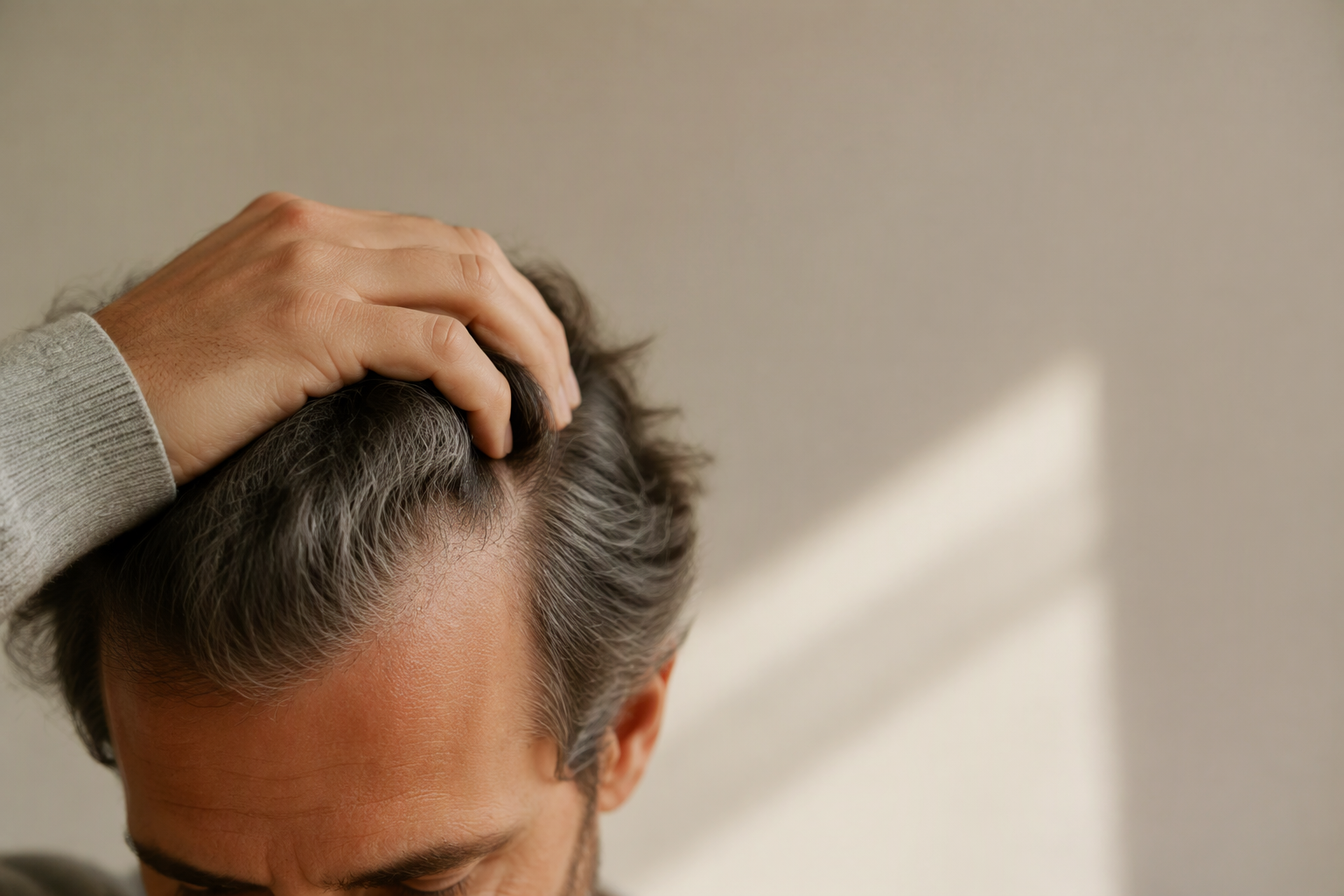
There is no single “best” treatment for every man. The right plan depends on the cause of the loss, its progression, the areas affected, treatment consistency, medical history, and how someone weighs possible benefits against side effects.
Success also needs a clear definition. It may mean slowing further loss, maintaining current coverage, thickening miniaturized hair, or producing visible regrowth. Those outcomes are not interchangeable.
We recommend beginning with a diagnosis and measurable objective rather than a product ranking. For an overview of medication choices and trade-offs, read our diagnosis-first guide to hair loss drugs.
Preservation, thickening, and regrowth are different outcomes
We separate the main goals as follows:
- Preservation: Slowing or stabilizing loss to retain existing coverage.
- Thickening: Making miniaturized hairs more cosmetically useful.
- Regrowth: Creating visible coverage in an area that has become thinner or bare.
Preservation may not produce a dramatic before-and-after photograph, but it can still be valuable. A stable hairline or crown may represent a successful result when the original concern was continuing loss.
Why “more hair” is not a precise treatment goal
A useful goal identifies both the area and the desired outcome. Examples include reducing crown visibility, stabilizing temple recession, or improving mid-scalp coverage.
Daily mirror checks do not provide a reliable comparison. Lighting, styling, hair length, moisture, and viewing angle can make the same hair look substantially different.
Can a Man's Hair Grow Back? A Stage-by-Stage Reality Check
Some men can achieve visible regrowth, particularly where hairs remain but have become finer. Complete restoration is not guaranteed, and areas with visible thinning may respond differently from areas that have been smooth and bald for years.
The pattern and stage provide context, not certainty. Results also depend on the diagnosis, selected treatment, consistency, health factors, and the area being treated.
Early thinning and active miniaturization
Early thinning with substantial remaining coverage often presents an opportunity to focus on preservation. The aim may be to stabilize loss and improve the appearance of vulnerable hairs rather than recreate an earlier hairline.
We recommend taking baseline photographs before treatment. Without them, gradual stabilization can be difficult to recognise.
Established thinning with visible scalp
Improvement may still be possible when the scalp is visible, although the final cosmetic effect varies. Hair thickness, colour, curl, length, and contrast with the scalp all influence the appearance of coverage.
The hairline, mid-scalp, and crown should be assessed separately. One area may appear stable while another continues to change.
Long-bald or smooth areas
Medication may be less likely to provide cosmetically meaningful coverage in areas that have been smooth for a long time. Thinning behind a receded hairline could respond differently from bare temples, for example.
If non-surgical treatment cannot meet the coverage goal, hair transplant surgery may be worth discussing with an appropriately qualified clinician.
Why Starting Earlier Often Beats Searching for the Perfect Treatment
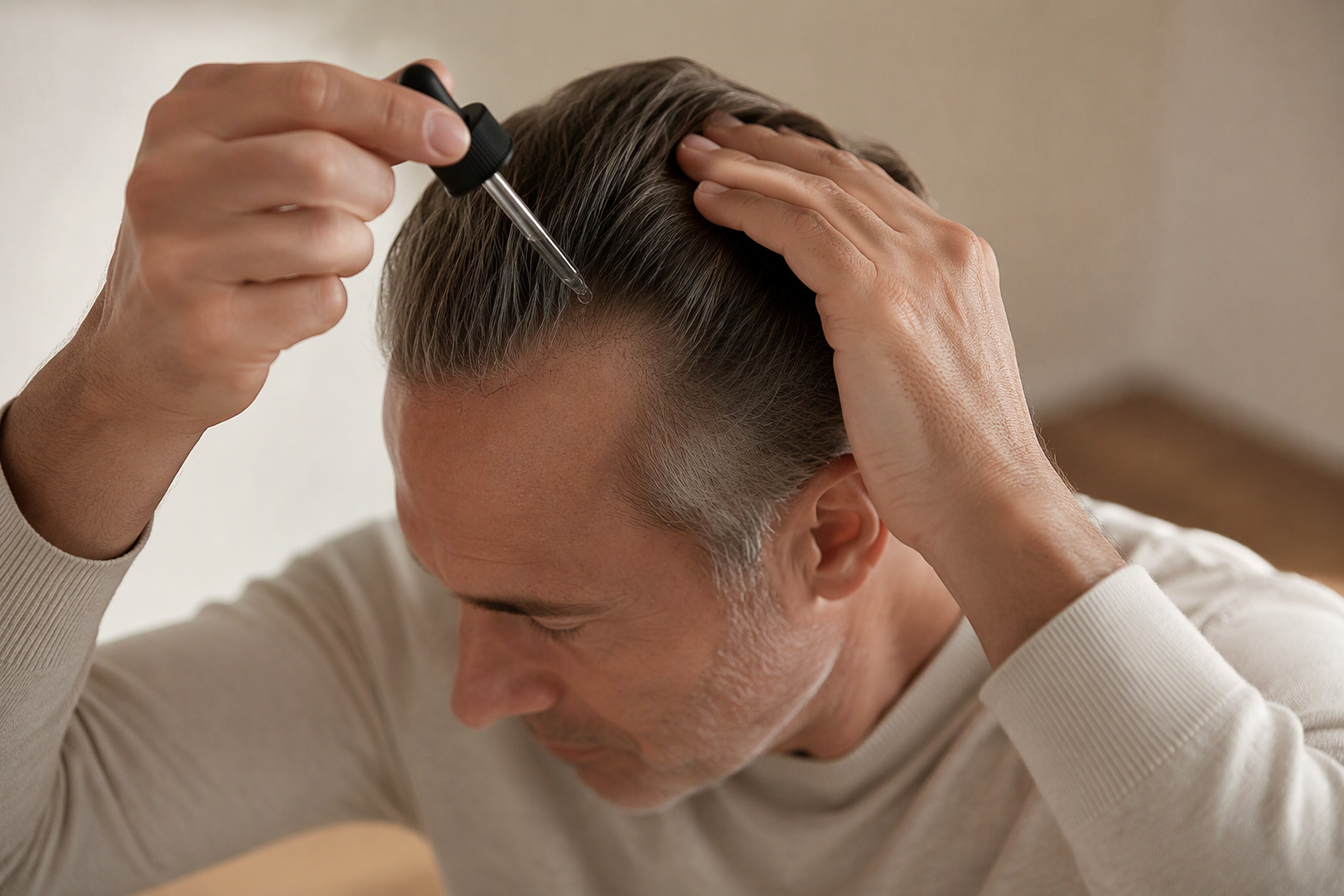
Delaying assessment while trying unsupported remedies may allow hair loss to continue. Starting earlier does not mean using every treatment available. It means identifying the likely cause, selecting a focused plan, and tracking the result.
The cost of waiting on shampoos, oils, and viral hacks
Cosmetic products may improve softness, breakage, styling, or scalp comfort without addressing the cause of progressive hair loss. Better-looking hair can be useful, but it is not the same as stabilising follicle miniaturisation.
“Natural” does not automatically mean effective or harmless. Supplements and botanical products may cause unwanted effects or interact with medicines.
Act early without treating blindly
Document the pattern, speed, and affected areas before beginning a long-term routine. Sudden shedding, defined patches, pain, inflammation, or scaling should not be assumed to be routine male-pattern hair loss.
Men comparing medication routes can use our hair loss treatment options guide to prepare for a clinician discussion.
What to Expect at Three, Six, and Twelve Months
Hair treatment is usually assessed over months rather than days. The following checkpoints are a practical monitoring framework, not a guarantee that a particular change will occur by a fixed date.
Temporary shedding can occur after some treatments begin, but shedding alone does not prove that a plan is working. Questions about worsening loss or adverse effects should be discussed with the prescribing clinician.
Months 0–3: establish tolerance and consistency
The early phase is useful for assessing adherence and tolerability. Record missed doses, scalp changes, symptoms, side effects, and any clear difference from the pretreatment pattern.
Avoid changing the routine in response to daily fluctuations unless a clinician advises it. Repeated changes make the outcome harder to interpret.
Months 3–6: look for stabilization, not miracles
Compare standardised photographs and look for an overall trend. Depending on the treatment and diagnosis, the most relevant sign may be stability rather than dramatic regrowth.
For someone with early diffuse thinning, similar photographs across several months could be encouraging if the previous pattern showed continued progression.
Months 6–12: judge the trend and next step
At later checkpoints, consider whether the plan has:
- Preserved existing coverage
- Improved apparent thickness or density
- Failed to control visible progression
- Created tolerability or adherence problems
A clinician can help decide whether to continue, adjust the plan, investigate another cause, or discuss an additional option. Significant side effects or rapid worsening warrant earlier review.
How to Track Hair Growth Without Being Misled by the Mirror
Memory is unreliable. Lighting, wet hair, styling, wash frequency, and normal shedding can distort the impression of progress.
Before-and-after photographs are also weak evidence when the camera angle, hair length, lighting, styling, or use of concealing fibres changes.
A standardized monthly photo protocol
Take photographs at regular intervals using the same:
- Room and light source
- Camera, distance, and angle
- Hair length and styling method
- Dry or wet condition
- Front, temple, mid-scalp, crown, and part-line views
The purpose is to identify a trend over time, not to react to individual good-hair or bad-hair days.
Useful measurements beyond photos
Record the treatment start date, missed doses, routine changes, symptoms, illnesses, side effects, and medication changes. Clinician-led photography or scalp assessment may provide additional context.
Treat shower-hair counts cautiously. Hair length, washing frequency, brushing, and drain visibility can change the count without proving that density has changed.
When to Stay the Course, Adjust the Plan, or Get Reassessed
Monitoring should support a decision. Continued loss does not automatically prove treatment failure; adherence, duration, diagnosis, and the previous rate of progression all need consideration.
We discourage unsupervised dose changes. A dermatologist or other qualified clinician should assess unclear diagnoses, rapid progression, or significant side effects.
Reasons to continue monitoring
Continuing the existing plan may be reasonable when:
- Treatment is consistent and tolerated
- The comparison period remains short
- Standardised photographs suggest stability
- No new warning signs have appeared
A lack of dramatic regrowth is not necessarily failure when preservation was the original goal.
Reasons to schedule a treatment review
Arrange a review if loss continues through the planned evaluation period, adherence is difficult, or side effects affect daily life. Reassessment also matters when the pattern does not resemble typical androgenetic alopecia.
Our guide to pre-treatment risk screening and side effects can help prepare for that conversation.
Red flags that warrant prompt clinical evaluation
Seek timely evaluation for:
- Rapid or sudden loss
- Sharply defined bald patches
- Scalp pain, burning, redness, or pustules
- Heavy scaling or signs of scarring
- Hair loss accompanied by other unexplained symptoms
- Loss following an illness or medication change
Male-pattern baldness is common, but it is not the only cause. More than one type of hair loss can also occur at the same time.
Why More Treatments Are Not Automatically Better
Combining numerous medicines, supplements, oils, devices, and procedures makes results and adverse effects harder to interpret. We prefer a focused plan with a baseline, defined goal, and scheduled reviews.
The attribution problem
When several interventions begin together, it becomes difficult to identify what helped, caused irritation, or made no difference. A complicated routine may also be harder to follow consistently.
Where clinically appropriate, changing one variable at a time can make its effects easier to assess.
Where devices and procedures may fit
Microneedling, low-level light devices, platelet-rich plasma, and transplantation may be discussed according to the diagnosis, stage, goals, evidence, budget, and clinical suitability.
Their roles differ. A procedure considered for long-bald temples may not be appropriate for someone whose main objective is preserving early diffuse thinning.
Personalizing Treatment Without Treating DNA as a Crystal Ball
Personalisation should combine diagnosis, pattern, stage, medical history, current medicines, preferences, risk tolerance, and follow-up. Genetic information may add context, but it cannot guarantee a response or rule out side effects.
At Roots by GA, we use genetic insight as one part of a wider personalised framework rather than as a standalone prediction.
The inputs that should shape a plan
A plan should account for:
- Pattern, speed, and duration of loss
- Family history and age
- Scalp findings and general health
- Current medicines and previous treatments
- Desired cosmetic outcome
- Preference for topical or systemic treatment
- Likely adherence
- Side-effect concerns and monitoring needs
Men considering systemic treatment can review the benefits and risks of oral minoxidil before discussing suitability with a prescriber.
What genetic information can and cannot do
Genetic information may provide context about inherited susceptibility. We use it alongside health history, hair-loss pattern, and clinical assessment.
DNA cannot confirm every diagnosis, promise regrowth, predict freedom from adverse effects, or replace appropriate examination and follow-up.
FAQ
What is the best solution for hair loss in men?
There is no universal best solution. The appropriate plan depends on the diagnosis, stage, affected areas, health history, goals, and risk tolerance. We recommend defining the intended outcome before comparing treatments.
What are the “big 3” hair loss treatments?
The phrase commonly refers to finasteride, minoxidil, and ketoconazole shampoo. However, they do not have identical purposes, evidence, risks, or suitability. The label should not replace individual assessment.
Can men treat hair loss naturally or entirely at home?
Some routines can be followed at home, but that does not establish effectiveness. Clinical evaluation is advisable when the cause is uncertain, loss is rapid or patchy, or the scalp is painful, inflamed, heavily scaled, or scarred.
Is there a hair loss treatment for men without side effects?
No active treatment can promise zero side effects for everyone. Screening, informed selection, and follow-up can help manage risk.
Can a man's hair grow back after hair loss?
Regrowth may occur where follicles still produce miniaturised hairs, but complete restoration is not guaranteed. Long-bald, smooth areas may have less potential from medication alone.
How long should a man wait before deciding treatment has failed?
Assessment generally requires months, but timing depends on the treatment and diagnosis. Significant side effects, rapid worsening, inflammation, or diagnostic uncertainty justify earlier review.
Build a Hair Loss Plan You Can Measure
Explore our personalized, genetics-informed hair loss approach to build a focused plan around your pattern, health context, goals, and measurable progress.
Roots by Genetic Arts
24 Oct 2026
Thanks for your order!
Login into your profile to set up your account.