
6 Nov 2026
Peptide for Hair Growth: A Label-First Buying Guide to Topical Serums
Learn how to assess peptide hair serums by ingredients, claims, evidence and hair-loss cause, so you can choose with confidence. Read the label-first guide.
Share


TL;DR
A peptide for hair growth may condition strands, reduce breakage or make existing hair look fuller. That does not mean it can regrow miniaturized follicles. Before buying a peptide serum, we recommend checking the finished formula, the exact claim, the quality of the human evidence and whether the product fits the likely cause of hair loss. For a progressively receding hairline, peptides are better treated as a possible adjunct—not an automatic replacement for pathway-matched treatment.
Table of Contents
- TL;DR
- Table of Contents
- Peptide for Hair Growth: What Are You Actually Buying?
- How to Decode a Peptide Hair Serum Label
- Does “Clinically Tested” Apply to the Ingredient or the Finished Serum?
- A Buy, Skip or Adjunct Scorecard for Peptide Serums
- Topical Peptide Serum vs Peptide Injection: Do Not Treat Them as Equivalent
- Peptide for Hair Growth Side Effects and Patch Testing
- How to Test a Peptide Serum Without Being Fooled by Before-and-After Photos
- What to Use When the Hairline Is Still Receding
- Peptide Hair Growth Questions Before You Buy
- FAQ
- Stop Guessing and Build a Pathway-Matched Plan
Peptide for Hair Growth: What Are You Actually Buying?
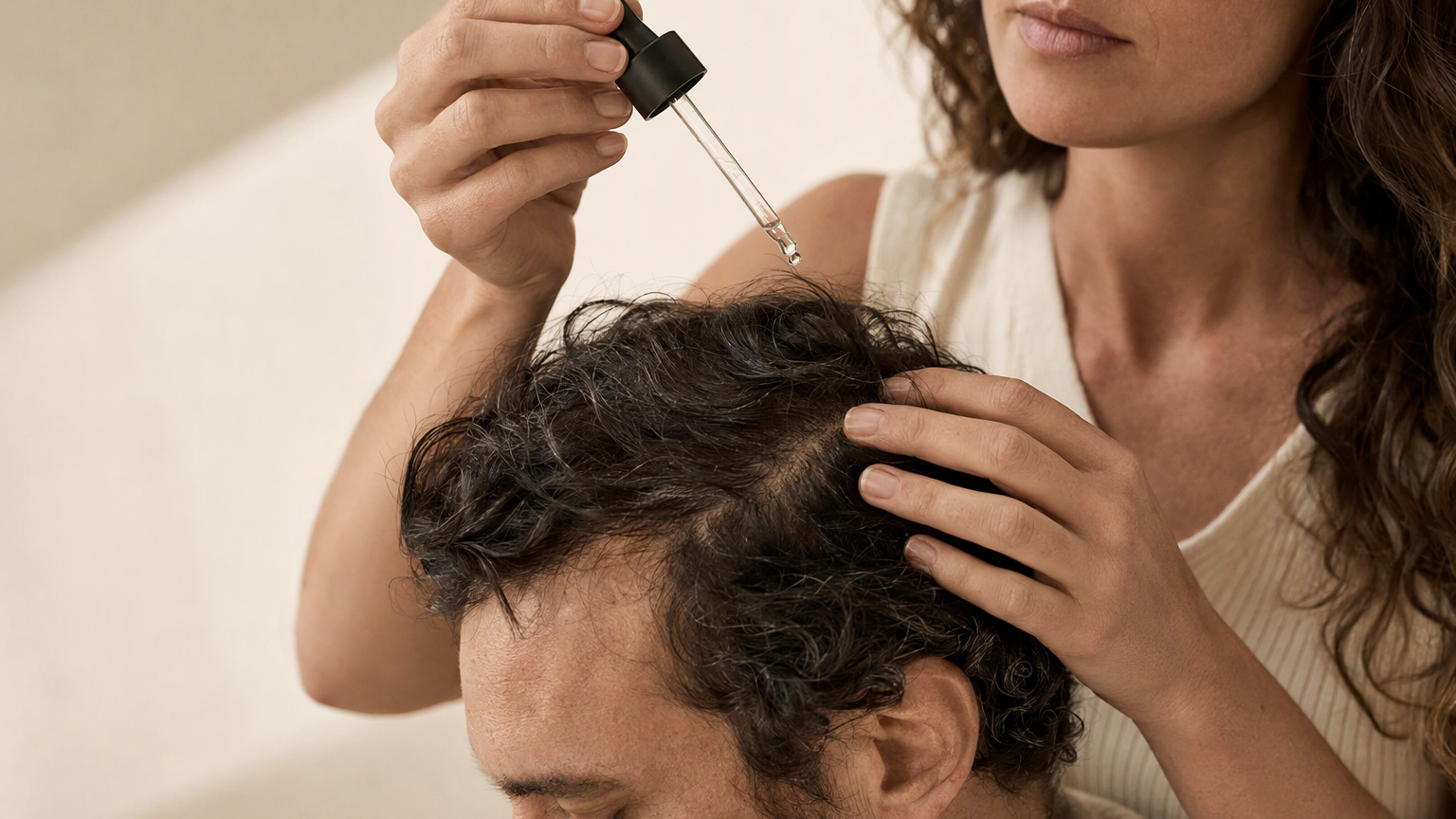
A serum may promise “peptide-powered” density, but is it affecting shrinking follicles or simply making existing hair feel thicker? Product pages do not always make that distinction clear.
“Peptide” can describe several things: a signaling ingredient, a conditioning protein fragment or a proprietary complex containing peptides alongside botanical extracts, solvents and conditioning agents. Products with similar front-label language may therefore have very different formulas, intended uses and levels of evidence.
This guide focuses on topical cosmetic serums. It is not a ranking of copper peptides, acetyl tetrapeptide-3, biotinoyl tripeptide-1 or experimental compounds discussed online.
We use a more practical standard: assess the exact formula being sold, the outcome it promises and whether that outcome fits the hair concern. An impressive ingredient name cannot compensate for vague claims, inaccessible evidence or a mismatch between the product and the underlying biology.
For an ingredient-level assessment, use our detailed peptide claim-auditing framework for genetic hair loss. Here, we focus on the next buying question: what does the bottle itself justify?
Regrowth, Thickness and Healthier-Looking Hair Are Different Outcomes
Hair-product marketing often blends outcomes that should remain separate:
- New or renewed follicular growth: More hair emerging from follicles or a meaningful improvement in follicles affected by miniaturization.
- Reduced breakage: Existing strands remain intact longer, which may make the hair look denser.
- Temporary fiber coating: Film-forming or conditioning ingredients make individual strands feel smoother or appear thicker.
- Improved scalp condition: Less dryness or irritation may support comfort and help someone maintain a consistent routine.
- Styling improvement: Better texture, lift or manageability can reduce visible scalp exposure.
Each benefit can be worthwhile. Reduced breakage matters, and a comfortable scalp is preferable to an irritated one. Neither result, however, automatically means a product has reversed androgenetic alopecia or another form of hair loss.
Read “supports thicker, fuller-looking hair” literally. The wording may refer to appearance, fiber condition or styling—not the creation of new terminal hairs.
That distinction matters when evaluating peptides for hair growth and thickness. A serum can deliver a genuine cosmetic benefit while still being the wrong product for progressive follicle miniaturization.
Why “Best Peptide” Is the Wrong First Question
Before asking which peptide is best, we first define the problem:
- Is the hairline moving backward at the temples?
- Is thinning spread across the top of the scalp?
- Did shedding increase suddenly?
- Are strands snapping through the lengths?
- Is the scalp itchy, inflamed or painful?
- Are smooth or irregular patches appearing?
These patterns may have different causes. Someone with progressive temple recession may have androgenetic alopecia, while a person seeing short, broken fibers may primarily have a hair-shaft problem. A cosmetic serum does not automatically address both.
Our principle is simple: identify the likely cause, then choose products aimed at the relevant pathway. Trending ingredients should not set the treatment strategy.
How to Decode a Peptide Hair Serum Label
The best peptide serum for hair growth cannot be identified by counting peptides or choosing the longest ingredient list. More ingredients do not prove that the peptides are present at useful concentrations, remain stable or reach their proposed target.
We recommend this front-label-to-ingredient-list workflow:
- Write down the exact promised outcome. Separate “fuller-looking” hair from reduced shedding, measured density or regrowth.
- Find the featured peptide in the ingredient list. Confirm that the advertised ingredient is disclosed.
- Review the complete formula. Look for conditioners, film formers, fragrances, essential oils and other featured ingredients.
- Check the directions. A leave-on scalp serum should explain how and where to apply it.
- Find the evidence. Determine whether the research involved the peptide, a supplier blend or the finished retail formula.
- Verify the manufacturer. Look for identifiable company information, contact details and complete ingredient disclosure.
- Compare price with uncertainty. A higher price does not turn an ingredient theory into proof for the finished product.
A label highlighting several “advanced peptides” is not necessarily better than one containing a single peptide. Formula quality depends on factors such as concentration, stability, delivery, tolerability and evidence—not the size of the peptide count.
Read the Claim Language Literally
Cosmetic language is often carefully qualified. Those qualifiers reveal what the company is—and is not—promising.
- “Fuller-looking hair” concerns visible appearance, not necessarily new growth.
- “Supports density” is ambiguous unless the company defines density and explains how it was measured.
- “Reduces breakage” refers to preserving existing strands, not generating new follicles.
- “Promotes a healthy scalp” may concern hydration, comfort or barrier condition.
- “Strengthens hair” usually describes the fiber rather than the follicle.
- “Helps hair appear thicker” may reflect strand coating, conditioning or styling.
A direct claim to treat hair loss or regrow miniaturized follicles is different from appearance language. It requires more relevant evidence than a claim about softness, body or healthier-looking hair.
We do not dismiss cosmetic benefits. We simply expect the likely result to match the words on the label.
Check Whether the Featured Peptide Appears in the Ingredient List
If a bottle highlights copper peptides, look for the corresponding ingredient name in the full list. Front-label prominence does not reveal the concentration, stability or biological importance of that ingredient.
Ingredient order can provide some context, but it does not disclose exact concentrations or prove that a peptide can reach its proposed target. It also cannot show whether the ingredient remains stable throughout the product’s shelf life.
“Proprietary peptide technology” is harder to assess. Without identifiable ingredients, concentration information or accessible research, buyers cannot meaningfully compare the retail formula with the material used in a study.
Watch for a disconnect between the hero ingredient and the overall formula. A serum may advertise a peptide while relying mainly on conditioning or film-forming ingredients for its immediate visible effect.
Check the Rest of the Formula
The peptide is only one part of a serum. Other ingredients can influence tolerability, cosmetic performance and the likelihood that someone will use the product consistently.
Review the label for:
- Fragrance or fragrant botanical extracts
- Essential oils
- Alcohols or solvents that may feel drying
- Conditioning polymers and silicones
- Humectants that support hydration
- Film-forming agents that temporarily increase body
- Other scalp-focused or hair-loss ingredients
A visible improvement after the first few applications is more likely to come from hydration, conditioning or styling than from a change in follicular growth. That does not make the result false; it clarifies the probable mechanism.
People with sensitive or inflamed scalps should pay close attention to non-peptide ingredients. A theoretically interesting peptide does not rescue a formula that repeatedly causes itching, burning or redness.
Does “Clinically Tested” Apply to the Ingredient or the Finished Serum?
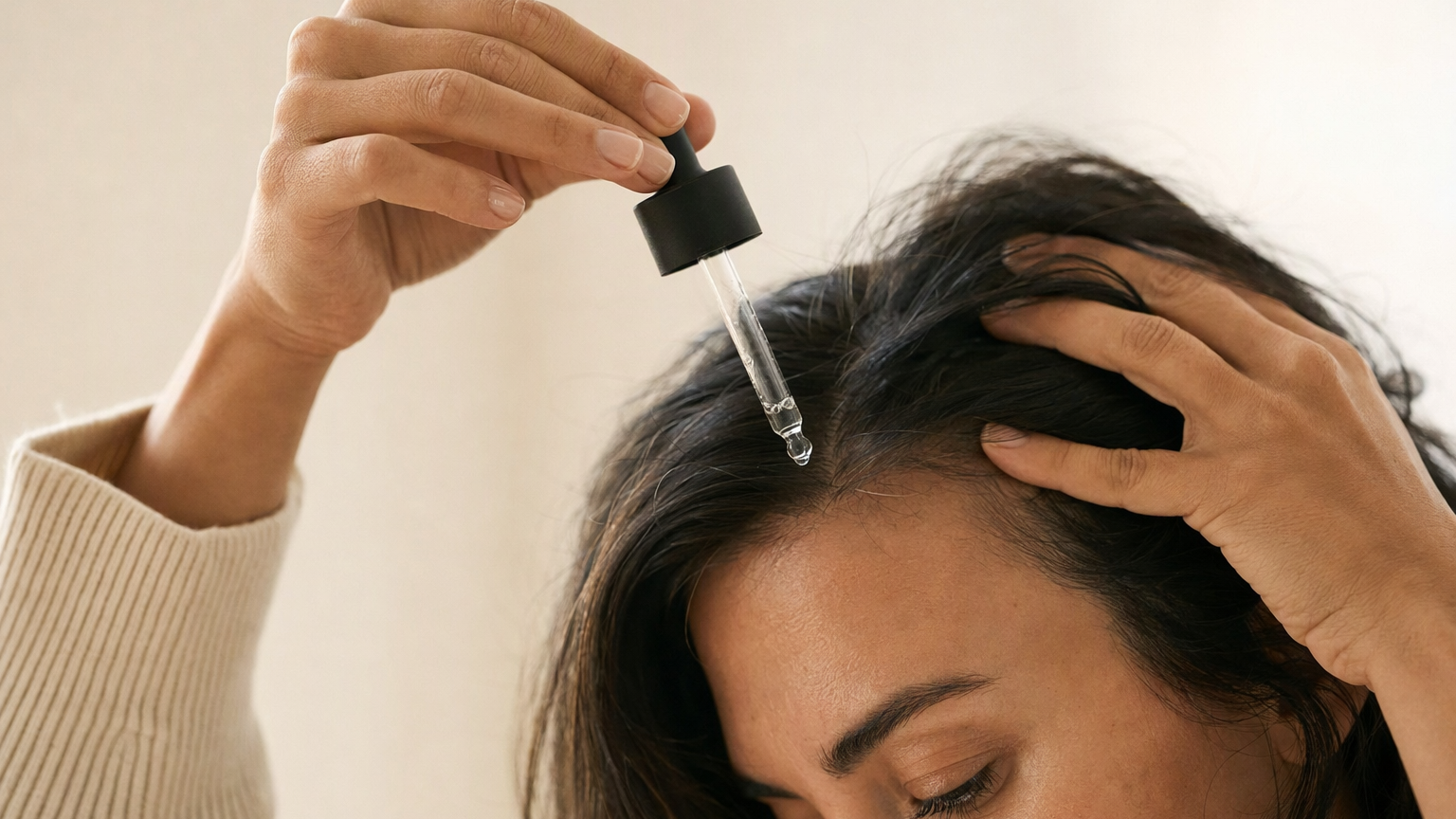
“Clinically tested” sounds definitive, but it can refer to very different levels of evidence:
- Research on an isolated peptide
- Research on a supplier-owned, multi-ingredient complex
- Research on the exact retail serum in the bottle
These categories are not interchangeable. If a supplier complex was studied under particular conditions, a retail product cannot automatically claim the same result without showing that its formula is sufficiently comparable.
The same problem arises when research tests an isolated peptide. A retail serum may use a different concentration, formula base, application schedule or combination of ingredients.
We look for an accessible citation rather than a polished graph with no study details. The evidence should make it possible to determine what was tested, who participated, how outcomes were measured and whether the sold formula matches the tested product.
Five Study Details Worth Checking
When a brand cites a clinical study, review these points.
-
Participants and diagnosis
Did the research include people? Did those participants have the hair concern relevant to the claim? Findings about general hair appearance cannot automatically establish efficacy for androgenetic alopecia.
-
Study design
Look for a comparison group, a clear treatment method and an explanation of how outcomes were assessed. Blinding can help reduce the influence of participant or investigator expectations.
-
Duration
Follicular change cannot be judged like instant skin hydration. A study should run long enough to assess the intended hair outcome rather than measuring only an immediate cosmetic effect.
-
Endpoints
Standardized hair counts, measured density and controlled photography are more informative for regrowth claims than satisfaction scores alone. Self-reported softness may support a conditioning claim, but it does not prove new growth.
-
Funding and replication
Supplier- or brand-funded research is not automatically invalid, but financial relationships should be transparent. Independent replication generally gives us more confidence than one study that has not been reproduced.
The key question is not merely, “Was there a study?” It is, “Does this study support this product, used this way, for this outcome?”
Red Flags in Product Evidence
We reconsider the strength of the evidence when:
- Only test-tube, animal or wound-healing studies are cited
- The study used a different formula from the retail product
- The tested complex was used at an undisclosed concentration
- The trial combined peptides with other active treatments or procedures
- Before-and-after images replace measured outcomes
- Satisfaction scores are presented as proof of follicular regrowth
- A graph has no citation or study details
- Testimonials are treated as clinical data
- The study examined hair fibers, but the marketing implies follicular regeneration
A common example is a serum advertising a “clinically studied peptide complex” when the cited research actually tested a supplier blend. Unless the retail formula matches the studied material in relevant ways, the evidence does not transfer automatically.
A Buy, Skip or Adjunct Scorecard for Peptide Serums
Instead of ranking peptides by name, we score the finished product across six categories. Assign zero, one or two points to each.
| Category | 0 points | 1 point | 2 points |
|---|---|---|---|
| Outcome clarity | Vague or dramatic claims | Qualified but imprecise | Specific, measurable outcome |
| Formula transparency | Key details hidden | Ingredients listed with little context | Complete disclosure and clear directions |
| Finished-product evidence | Testimonials only | Ingredient or supplier evidence | Relevant human evidence on the sold formula |
| Pathway fit | Does not address the likely cause | Supportive or uncertain fit | Credible fit for the defined goal |
| Tolerability | Irritating or unclear | Some concerns | Appropriate and well tolerated |
| Price vs uncertainty | High cost with weak support | Acceptable trade-off | Cost proportionate to evidence and goal |
We interpret the total cautiously:
- 10–12: A more defensible purchase for its stated purpose, though not proof that it will work for everyone.
- 6–9: Consider it only with realistic expectations.
- 0–5: Skip it or ask the seller for better information.
This scorecard does not turn a cosmetic into an approved hair-loss treatment. It helps us judge whether a product is transparent, reasonably supported and aligned with its stated role.
Consider Buying When
A peptide serum may be reasonable when:
- The desired benefit matches the evidence, such as conditioning, reduced breakage or scalp support
- The claim language distinguishes appearance from regrowth
- The full formula and manufacturer are identifiable
- The serum is tolerable and practical to use
- Its cost will not displace a treatment more relevant to the likely cause
- It is being used as an adjunct rather than assumed to be a standalone regrowth therapy
For someone prioritizing softer hair, reduced breakage or improved scalp comfort, a well-formulated serum may earn a place in the routine. That is a different purchasing decision from treating progressive male pattern hair loss.
Skip or Reconsider When
We recommend skipping or reconsidering a product when:
- It promises dramatic hairline restoration without relevant human evidence on the finished formula
- It hides behind “proprietary technology” without identifying key ingredients
- Testimonials and star ratings carry the entire argument
- Limited-time offers create artificial urgency
- Celebrity speculation is presented as proof
- Before-and-after photos change lighting, angle, styling or hair length
- The price is high relative to the uncertainty
- Buying it would delay assessment of rapid, patchy or unexplained hair loss
Reviews also require context. If a reviewer started minoxidil, supplements, microneedling and a peptide serum at the same time, that account cannot isolate the serum’s contribution.
Treat It as an Adjunct When Genetic Loss Is Progressing
Androgenetic alopecia involves progressive follicle miniaturization. Affected follicles produce shorter, finer hairs over time, making the scalp more visible.
A cosmetic peptide serum does not automatically address the androgen-related pathway behind that progression. Even a biologically plausible ingredient should not be assumed to stop miniaturization without relevant clinical evidence.
When a hairline is actively receding, we position peptide products as optional support for cosmetic appearance, fiber condition or scalp comfort. Our stage-by-stage roadmap to hair loss treatment for men explains how treatment priorities can change with the pattern and extent of loss.
Topical Peptide Serum vs Peptide Injection: Do Not Treat Them as Equivalent
A topical cosmetic serum and an injected research peptide are fundamentally different product categories. They differ in exposure, regulatory status, sterility requirements, dosing questions and potential systemic risk.
Online discussion does not establish that an injectable peptide is approved, effective or safe for hair loss. It also cannot establish an appropriate dose, manufacturing standard or long-term safety profile.
We do not recommend sourcing or self-injecting research peptides for hair growth. Anyone considering an injected or systemic product should speak with a qualified medical professional rather than following forum protocols.
Why BPC-157 Claims Should Not Drive a Purchase
BPC-157 is often discussed through theories involving tissue repair and wound healing. Those theories do not establish that it safely or effectively treats androgenetic alopecia.
Hair-related claims rely heavily on mechanistic extrapolation and anecdotes rather than controlled human research measuring relevant hair outcomes. A biological theory can justify further investigation, but it cannot substitute for clinical evidence.
BPC-157 should not be presented as a validated peptide for hair growth. Our broader evidence review of peptides and genetic hair loss examines the difference between plausible mechanisms and demonstrated clinical outcomes.
Cosmetic, Compounded and FDA-Approved Are Not Interchangeable
A topical cosmetic can be sold without being FDA-approved to treat hair loss. Market availability should not be mistaken for approval of a therapeutic claim. No peptide is currently FDA-approved as a treatment for hair loss.
A clinician-prescribed compounded product belongs to another category. Compounding may allow individualized ingredients or formats, but a compounded formulation is not automatically equivalent to an FDA-approved drug for a specific indication.
The distinctions matter:
- Cosmetic: Intended primarily to cleanse, condition or alter appearance
- Compounded prescription: Prepared under professional oversight for an individual patient
- FDA-approved drug: Reviewed through a regulatory pathway for a defined indication
- Research peptide: May lack approved dosing and adequate human safety or efficacy data for hair loss
Injected and systemic products warrant medical guidance. Uncertain purity, sterility, dosing and systemic effects make self-experimentation a poor trade.
Peptide for Hair Growth Side Effects and Patch Testing
Topical peptide serums are sometimes marketed as gentler alternatives to established treatments. That does not mean every formula is risk-free or that “cosmetic” automatically means safer.
Possible topical reactions include:
- Redness
- Itching
- Burning or stinging
- Dryness or flaking
- Contact allergy
- Follicle-area bumps
- Worsening of an existing scalp condition
The peptide may not be responsible. Fragrance, essential oils, preservatives, solvents and botanical extracts can also trigger irritation.
The uncertainty is greater with unapproved injectable or systemic peptides. Risks cannot be inferred from topical cosmetic use, and a lack of good safety evidence should never be interpreted as evidence of safety.
How to Patch Test a Topical Serum
Follow the manufacturer’s directions and test the serum on a small area before applying it broadly. Avoid broken, infected or markedly inflamed skin unless a clinician advises otherwise.
Watch for persistent redness, itching, burning, swelling or rash. Stop using the product and seek professional guidance if symptoms are severe, spread beyond the application area or do not settle.
Patch testing can reduce avoidable surprises, but it cannot guarantee that irritation or allergy will never develop with repeated use.
When Hair Loss Itself Needs Medical Attention
Do not use another cosmetic to conceal a pattern that warrants assessment. Seek medical guidance for:
- Sudden or heavy shedding
- Smooth or irregular patches of loss
- Scalp pain, marked itching or burning
- Redness, crusting, pustules or substantial scaling
- Shiny areas or other possible signs of scarring
- Hair loss following illness or medication changes
- Loss accompanied by fatigue, weight changes or other systemic symptoms
- Rapid progression without a clear explanation
These features may point away from routine genetic thinning or indicate several contributing factors. The priority is identifying the cause, not finding a more expensive serum.
How to Test a Peptide Serum Without Being Fooled by Before-and-After Photos
Personal tracking is useful, but it is not a clinical trial. There is no control group, blinding or reliable way to eliminate every competing explanation.
Even so, a standardized process is better than daily mirror checks. We recommend taking baseline photographs before starting and comparing them at consistent intervals under controlled conditions.
Track outcomes separately:
- Hairline position
- Visible scalp or density appearance
- Shedding
- Breakage
- Scalp comfort
- Styling and manageability
- Adverse effects
Do not combine these observations into a vague conclusion that “it works.” Less breakage should be recorded as less breakage—not relabeled as regrowth.
Standardize Every Photo
Keep the following consistent:
- Room and background
- Lighting source and brightness
- Camera and lens
- Camera distance and height
- Head angle
- Hairstyle and part placement
- Wet or dry hair state
- Amount of product in the hair
Photograph the front, both temples, top and crown where relevant. Dry, unstyled hair often provides a more consistent comparison than hair arranged to cover thinning areas.
Avoid hair fibers, concealers and volumizing products in tracking photos. Do not compare a fresh, short haircut with longer hair or a photo taken under harsh overhead lighting with one taken beside a soft window.
Control the Variables
Keep a dated record of other changes, including:
- Prescription or nonprescription hair treatments
- Procedures such as microneedling or transplantation
- Supplements
- Major dietary changes
- Illnesses or high-fever events
- Medication changes
- Significant stressors
- Haircuts, coloring or chemical processing
If several interventions begin together, later improvement cannot reliably be credited to the peptide serum alone. Apply the same caution to online reviews that combine serums with minoxidil, supplements or procedures.
Set a Decision Date Before Starting
Decide what outcome would justify continued use and spending. If relevant finished-product research is available, its study period can provide context, but it does not guarantee an individual result.
Softness, manageability or scalp comfort may change relatively quickly. Claims involving follicular growth require longer observation and more rigorous measurement.
Reassess earlier if irritation develops, shedding accelerates or the hairline continues to recede. An optional adjunct should not delay assessment while the underlying condition progresses.
What to Use When the Hairline Is Still Receding
Progressive temple recession or thinning across the top of the scalp may warrant assessment for androgenetic alopecia. At that point, the central question is no longer whether a serum makes hair feel fuller. It is whether the plan addresses ongoing follicle miniaturization.
Peptides may support cosmetic or scalp-care goals. Treatments such as minoxidil and prescription options may have a more direct role in managing pattern hair loss, depending on the individual. Suitability, response and side effects vary, so treatment decisions should be made with appropriate professional guidance.
Medication concerns deserve an individualized risk-benefit discussion. “Natural,” “cosmetic” and “peptide-based” do not guarantee effectiveness or freedom from adverse effects.
At Roots by Genetic Arts, we focus on personalized genetic hair-loss treatment rather than selecting products by trend. Personalization is useful when it connects the pattern of loss, biology, goals and risk tolerance to a plan that can be monitored.
Start With the Cause, Not the Trend
We assess:
- The pattern and location of thinning
- How quickly it is progressing
- Family history
- Recent changes in shedding
- Scalp symptoms
- Illnesses and medication changes
- Breakage or grooming practices
- Other plausible causes
Timely, pathway-matched intervention can matter when follicles are progressively miniaturizing. Repeated trials of weakly supported cosmetics may delay a more relevant assessment.
That does not mean everyone needs the same medication. It means the likely biological target should come before the marketing category.
Build a Plan You Can Evaluate
A useful plan includes:
- A working assessment of the cause
- Defined treatment and cosmetic goals
- Baseline photographs
- A record of shedding, symptoms and tolerability
- A follow-up date
- Criteria for continuing, changing or stopping each product
Use a peptide product only in a role supported by its evidence and the intended goal. If the goal is reduced breakage, evaluate breakage. If the goal is hairline regrowth, require evidence and measurements relevant to the hairline.
Before selecting topical or oral therapy, review the side effects to consider during personalized hair-loss treatment. A structured risk discussion is more useful than assuming every cosmetic is safe or every medication is unacceptable.
Peptide Hair Growth Questions Before You Buy
What Is the Best Peptide for Hair Growth?
There is no universally best peptide. A better question is whether the finished topical product has credible evidence for its intended outcome and the relevant type of hair loss.
An ingredient may have laboratory or supplier-level support without proving that every serum containing it regrows hair. We check the complete formula, available concentration information, delivery system, human evidence and pathway fit.
Among commonly discussed ingredients, GHK-Cu has more hair-specific support than many experimental peptides. That still does not mean every GHK-Cu serum has been shown to treat hair loss.
Do Peptides Actually Work for Hair Growth?
Some peptide products may support scalp condition, reduce breakage or improve the appearance of density. Those benefits do not automatically demonstrate new follicular growth or reversal of genetic miniaturization.
Evidence should be assessed at two levels: what is known about the ingredient and what has been demonstrated for the finished retail formula. Strong ingredient marketing cannot fill an evidence gap for the product in the bottle.
Can BPC-157 Help Hair Growth?
BPC-157 is not a validated treatment for androgenetic alopecia. Online claims are largely based on anecdotes, proposed mechanisms and extrapolation from research that did not establish controlled human hair-regrowth outcomes.
We recommend against self-injection. Questions about dosing, sterility, purity, efficacy and long-term safety belong with qualified medical professionals—not online protocols.
Are Peptide Serums Different for Women?
The same label-first buying framework applies, but the causes of thinning and appropriate treatment plans may differ. Gendered packaging does not establish that a formula addresses the underlying cause.
Persistent, sudden or unexplained loss deserves assessment. Hormonal factors, illness, nutritional problems, medications, genetic thinning and inflammatory conditions may require different approaches.
What Did Elon Musk Use to Regrow His Hair?
There is no reliable public evidence proving that Elon Musk used a specific peptide regimen. Changes in appearance cannot identify which medication, cosmetic, styling method or procedure a public figure may have used.
Celebrity speculation is not a sound product-selection standard. Evidence for the finished formula and relevance to the diagnosed cause matter more than comparisons between public photographs.
Should Reddit Reviews Influence the Decision?
Reddit reviews can reveal practical issues such as residue, odor, irritation or difficult application. They cannot establish that a serum causes regrowth.
Check whether reviewers used other treatments, changed their haircut or lighting, received free products or selected only flattering photos. Anecdotes can generate useful questions, but they cannot answer efficacy conclusively.
FAQ
How Can I Tell Whether a Peptide Serum Is Cosmetic or Therapeutic?
Start with the claim language. Phrases such as “fuller-looking,” “strengthens” and “supports a healthy scalp” usually describe cosmetic outcomes. A claim to treat hair loss or reverse miniaturization is therapeutic and requires stronger evidence. Product availability alone does not mean the FDA has approved it for hair-loss treatment.
Does a Higher Peptide Concentration Make a Serum Better?
Not automatically. Concentration matters alongside peptide identity, stability, delivery, tolerability and evidence for that amount in the finished formula. A percentage on a label may refer to a diluted complex rather than the peptide itself, so context matters.
Can I Use a Peptide Serum With Another Hair-Loss Treatment?
Possibly, but compatibility depends on the formulas and the scalp’s response. Layering several products can increase irritation and make it harder to identify what caused a benefit or adverse effect. A clinician or pharmacist can help assess combinations involving prescription, compounded or medicated treatments.
How Long Should I Test a Peptide Hair Serum?
Match the test period to the promised outcome and available evidence. Conditioning or scalp-comfort changes may appear sooner than follicular changes. Set a decision date before starting, take standardized photographs and reassess promptly if irritation develops or the loss continues to progress.
Are Expensive Peptide Serums More Likely to Regrow Hair?
No. Price can reflect branding, packaging, formula complexity or proprietary ingredients, but it does not prove regrowth. We assess outcome clarity, ingredient disclosure, finished-product human evidence, tolerability and pathway fit. An expensive cosmetic remains a cosmetic when the evidence supports appearance rather than reversal of hair loss.
Stop Guessing and Build a Pathway-Matched Plan
If the hairline is still receding, do not let another loosely supported serum delay a cause-focused assessment. Explore personalized genetic hair-loss treatment at Roots by Genetic Arts and build a measurable plan around the pathway, evidence and risks that apply to your hair loss.
Roots by Genetic Arts
6 Nov 2026
Thanks for your order!
Login into your profile to set up your account.