
27 Oct 2026
Pre-Treatment Risk Screening: What Side Effects Should I Consider Before Starting a Personalized Topical or Oral Hair Loss Treatment?
Review topical and oral hair loss treatment side effects, baseline checks, interactions, and warning signs to discuss with a clinician before you start.

Share


TL;DR
What side effects should I consider before starting a personalized topical or oral hair loss treatment? The answer depends on the ingredients, route, health history, medications, scalp condition, and reproductive goals involved. Before treatment, we recommend documenting a relevant baseline, reviewing possible interactions with a qualified clinician, and agreeing on follow-up and warning signs. Personalization cannot remove every risk, but it can replace guesswork with a clearer, more informed plan.
Table of Contents
- TL;DR
- Table of Contents
- Hair Loss Treatment Checklist Before Your First Dose
- What Personalized Hair Loss Treatment Should Mean
- Health History Details That May Affect Treatment
- Bring a Complete Medication and Supplement List
- Baseline Measurements for More Useful Follow-Up
- Topical Treatment Does Not Guarantee Zero Systemic Exposure
- Choose a Start Plan That Is Easier to Interpret
- Agree on Monitoring and Escalation Before Treatment
- Questions to Ask Your Clinician Before Treatment
- FAQ
- Build Your Pre-Treatment Plan
Hair Loss Treatment Checklist Before Your First Dose
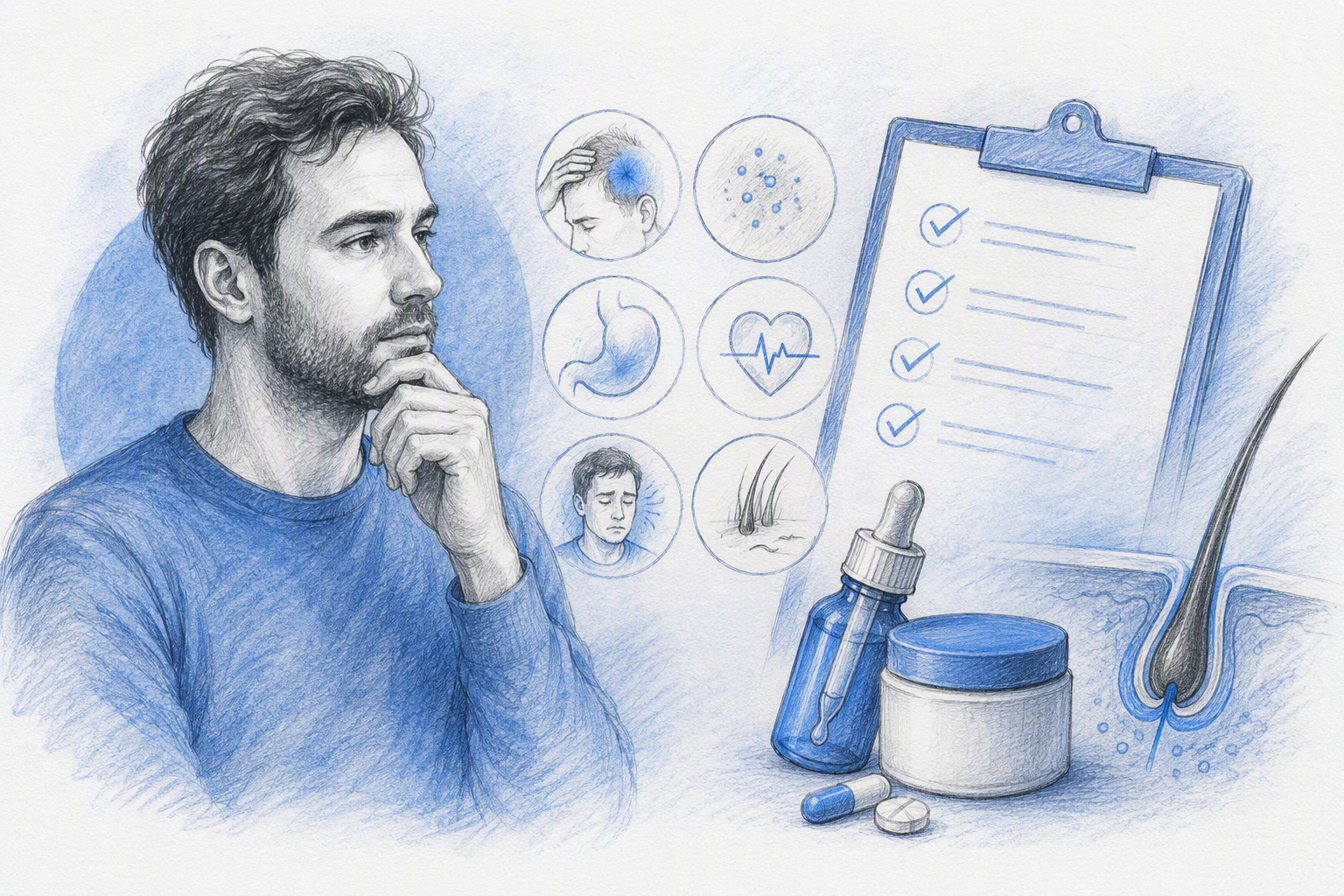
This checklist complements our guide to what side effects to consider before starting personalized topical or oral hair-loss treatment. Here, we focus on screening and monitoring before treatment begins.
No questionnaire, genetic report, or clinical assessment can guarantee whether a reaction will occur. Pre-treatment screening helps identify concerns; it does not eliminate risk.
We recommend four steps:
- Review health history, medications, supplements, and treatment priorities.
- Document relevant symptoms and baseline measurements.
- Select the simplest suitable starting plan with a clinician.
- Define follow-up timing, warning signs, and escalation steps.
Stop Guessing and Establish a Baseline
Once treatment starts, it can be difficult to remember whether dizziness, shedding, scalp irritation, mood changes, or sexual symptoms were already present.
Record only what is relevant to the proposed treatment. A clinician may suggest blood pressure, pulse, scalp photographs, current shedding, existing symptoms, or scalp condition. This should be a practical reference point, not a daily surveillance project.
What Personalized Hair Loss Treatment Should Mean
A personalized plan may adjust the active ingredient, topical or oral route, dose or concentration, formulation, application area, schedule, and monitoring plan.
Those choices should reflect health history, treatment goals, risk tolerance, convenience, and the ability to follow the plan consistently. A pre-consultation case file based on symptoms, health history, and likely causes may provide better context than a generic questionnaire.
More ingredients do not automatically mean better personalization. Sometimes the more appropriate choice is a simpler formula.
What Genetic Insights Can and Cannot Tell Us
At rootsbyga.com, we treat genetic insights as one source of decision support. They do not replace medical history, clinical judgment, treatment goals, or follow-up.
A genetic report cannot guarantee effectiveness or predict every adverse reaction. We do not view it as a promise of side-effect-free treatment.
Why a Simple Starting Plan Can Help
Introducing fewer variables may make benefits and unwanted changes easier to interpret. When several active ingredients start together, identifying the responsible ingredient can be difficult.
Combination treatment may still be appropriate. If a clinician recommends it, every ingredient should be documented and included in the monitoring discussion.
Health History Details That May Affect Treatment

A consultation should consider the individual rather than recite a generic list of adverse effects. Relevant details may include cardiovascular conditions, low blood pressure, fainting, swelling, kidney concerns, allergies, scalp disease, mental health, sexual health, fertility goals, and reproductive plans.
Mention conditions even if they seem unrelated to hair. Their relevance depends on the proposed ingredient, route, dose, and wider clinical context.
Cardiovascular and Blood Pressure Questions
Tell the clinician about dizziness when standing, palpitations, fainting, chest symptoms, unexplained swelling, low blood pressure, or a diagnosed heart condition.
These details warrant discussion when systemic exposure is possible. For example, a clinician may want baseline readings before considering oral minoxidil. Our guide to oral minoxidil effectiveness, dosage, side effects, and safety can help prepare questions, but it does not replace medical advice.
Mental Health, Sexual Health, and Fertility Goals
Discuss existing mood or sexual symptoms before treatment. A baseline makes later changes easier to describe without assuming that treatment caused them.
Fertility goals, pregnancy, breastfeeding, and reproductive plans should be raised before a prescription or compounded formula is finalized.
Scalp Health and Skin-Barrier Condition
Dermatitis, cuts, sunburn, inflammation, or recent scalp procedures may affect topical tolerability. Show the clinician any active scalp problem and ask whether it should be addressed before application begins.
Bring a Complete Medication and Supplement List
Include prescriptions, over-the-counter medicines, vitamins, herbal supplements, pre-workout products, topical medicines, and recreational substances when clinically relevant.
A clinician or pharmacist may need to review products that affect blood pressure, circulation, pulse, or fluid balance. Do not assume that a low dose removes the possibility of an interaction.
What to Record for Every Product
For each product, note its name, ingredients, strength, schedule, purpose, and how long it has been used. Include topical products and supplements rather than deciding in advance that they are irrelevant.
Do Not Change Existing Medication Yourself
Do not stop, skip, or alter prescribed medication to accommodate hair-loss treatment. Discuss whether the hair-loss plan should use a different ingredient, route, dose, formulation, or schedule instead.
Baseline Measurements for More Useful Follow-Up
Monitoring should match the proposed treatment and personal health history. Not everyone needs every measurement.
Objective Baseline Data
A clinician may recommend blood pressure, pulse, standardized scalp photographs, or a record of existing swelling. Follow the measurement instructions provided; readings taken under inconsistent conditions may be difficult to compare.
A Private Symptom Baseline
Briefly record existing dizziness, headaches, mood or sexual symptoms, scalp irritation, shedding, and palpitations when relevant. This record can support a more precise clinical conversation, but it cannot prove what caused a later symptom.
Consistent Progress Photography
Photograph the same scalp areas with similar lighting, angles, parting, hair condition, and styling. Compare images at planned intervals rather than reacting to small day-to-day differences.
Topical Treatment Does Not Guarantee Zero Systemic Exposure
Topical treatment is applied locally, but that does not guarantee that exposure remains entirely local. Absorption may depend on the formulation, concentration, amount, treatment area, application frequency, skin condition, and technique.
Oral treatment is not automatically unsuitable, and topical treatment is not automatically risk-free. Route selection should consider health factors, preferences, convenience, and likely adherence.
Factors That May Affect Topical Absorption
Using more than directed, applying over a larger area, treating broken or inflamed skin, or increasing application frequency may change exposure or irritation.
Do not compensate for a missed application with extra product unless the prescriber specifically directs it.
Questions to Ask About the Formulation
Ask for the active ingredients, concentrations, application amount, treatment area, drying instructions, hand-washing guidance, and missed-dose instructions.
For a compounded formula, confirm every active ingredient. If several are included, ask how the plan would be adjusted if a problem developed.
Choose a Start Plan That Is Easier to Interpret
A clinician-guided stepwise start may reduce uncertainty when several treatments are being considered. Dose, route, and formulation can sometimes be adjusted, but changes should come from the prescriber rather than improvised dosing.
Single-Active Versus Combination Formulas
A single-active formula has fewer variables. A combination formula may be convenient and clinically appropriate for some people.
Neither is universally superior. We recommend asking why each component is included and how the formula would be modified if tolerability became a concern.
Write Down the Exact Start Plan
Record the start date, dose or application amount, frequency, treatment area, planned titration, and missed-dose instructions. Keep this information accessible so the clinician can assess what was actually used if symptoms appear.
Agree on Monitoring and Escalation Before Treatment
Before starting, clarify which changes can be monitored, which require a call, and which warrant urgent care.
- Monitor: Mild changes that the clinician has already discussed.
- Contact the prescriber: Persistent, worsening, distressing, or function-limiting symptoms.
- Seek urgent medical care: Chest pain, fainting, breathing difficulty, serious allergic symptoms, severe dizziness, significant swelling, a rapid or irregular heartbeat, or concerning mood changes.
Set Follow-Up Timing in Advance
Ask when the first check-in should occur, whether home measurements are needed, and whom to contact if symptoms develop. Useful details may include timing, severity, dose, application area, medication changes, requested readings, and photographs of visible reactions.
Know What Should Not Be Pushed Through
A new symptom does not prove that treatment is working. Cardiovascular, allergic, severe, sexual, or mood-related symptoms deserve clinical review rather than reassurance from social media.
Early Shedding Versus a Possible Adverse Reaction
Some treatments may be associated with changes in shedding, but that should not become a blanket explanation for every symptom or worsening pattern.
If the distinction is unclear, contact the clinician instead of self-diagnosing or abruptly changing treatment. Our comprehensive topical and oral treatment side-effect guide provides further ingredient- and route-specific context.
Questions to Ask Your Clinician Before Treatment
A useful consultation should explain why the ingredient, route, dose, and formulation fit the individual’s history and priorities.
The Pre-Start Consultation Checklist
- What exactly is personalized in this plan?
- Could any condition, medicine, supplement, allergy, or reproductive goal change the recommendation?
- Why is this route appropriate?
- Which baseline measurements should be collected?
- What are the dosing and missed-dose instructions?
- Which changes require a call or urgent care?
- When will tolerability and effectiveness be reviewed?
- How can the plan be adjusted if it is ineffective or poorly tolerated?
- If this is a combination formula, how would a problem ingredient be identified?
FAQ
What should I check before starting hair-loss treatment?
Review medical history, medications, supplements, scalp condition, treatment goals, allergies, and reproductive considerations. A clinician can determine which baseline measurements are relevant.
Does topical hair-loss treatment stay completely local?
Not necessarily. Exposure may vary with the formulation, amount, treatment area, scalp condition, and application technique. Use the product only as directed.
Does shedding mean treatment is working?
Not automatically. Document its timing and pattern, then ask the prescribing clinician whether it fits the expected response. Do not use shedding to dismiss other symptoms.
Should I start several hair-loss ingredients at once?
Only when the prescribing clinician considers the combination appropriate. Starting several ingredients together can make benefits and adverse effects harder to attribute.
When should I contact a clinician about side effects?
Contact the prescriber about persistent, worsening, distressing, or function-limiting symptoms. Seek urgent care for severe or potentially dangerous symptoms, including breathing difficulty, chest pain, fainting, or signs of a serious allergic reaction.
Build Your Pre-Treatment Plan
Explore our genetics-informed approach at rootsbyga.com, then take your health history, medication list, baseline notes, and treatment questions to a qualified clinician before starting topical or oral hair-loss treatment.
Roots by Genetic Arts
27 Oct 2026
Related Posts
-

What Side Effects Should I Consider Before Starting a Personalized Topical or Oral Hair Loss Treatment?
Learn the key side effects of personalized topical and oral hair loss treatments, including scalp, heart, sexual, and mood risks. Review what to ask.
Read more
Thanks for your order!
Login into your profile to set up your account.