
22 Oct 2026
Compare Leading Online Hair Loss Treatment Plans That May Include Minoxidil, Finasteride, Supplements, or Customized Formulas
Compare minoxidil, finasteride, supplements, custom formulas, screening, costs, and cancellation terms to find a sustainable plan. Review your options.

Share


TL;DR
We compare leading online hair loss treatment plans that may include minoxidil, finasteride, supplements, or customized formulas by looking beyond price and convenience. The strongest plan is not the bundle with the longest ingredient list. It is the one that fits the diagnosis, medical history, preferences, risk tolerance, and ability to remain consistent.
We recommend comparing exact formulas, clinical screening, monitoring, ongoing cost, and cancellation terms—not quiz results, introductory prices, or “custom” labels alone.
Table of Contents
- Compare Leading Online Hair Loss Treatment Plans That May Include Minoxidil, Finasteride, Supplements, or Customized Formulas
- Personalized Hair Loss Care or a Standard Bundle? How to Tell
- Minoxidil vs. Finasteride: Mechanisms, Evidence, and Tradeoffs
- Topical vs. Oral Hair Loss Treatment Plans
- Oral Minoxidil 2.5 mg: Uses, Off-Label Status, and Side Effects
- Finasteride Benefits, Side Effects, and Informed-Consent Questions
- Supplements and Compounded Formulas: When More Is Not Better
- True Cost, Refill Terms, Clinician Access, and Long-Term Fit
- Timelines, Progress Tracking, and When to See a Dermatologist
- FAQ
- Build a Hair Loss Plan Around Your Biology
Compare Leading Online Hair Loss Treatment Plans That May Include Minoxidil, Finasteride, Supplements, or Customized Formulas

“Personalized” should mean more than placing a customer’s name on a standard subscription. When we compare plans, we start with a basic question: does the treatment fit the person?
There is no universal winner. A plan that may suit a man with gradual crown thinning and no relevant contraindications could be inappropriate for someone with sudden shedding, cardiovascular concerns, scalp inflammation, or different treatment priorities.
We therefore compare plan structures and standards of care rather than declaring one subscription the best hair loss treatment for every patient. A useful comparison should establish:
- What the plan contains
- Why each component was selected
- Whether the proposed diagnosis is reasonable
- Which risks and alternatives were discussed
- Who monitors treatment
- What happens if treatment is ineffective or poorly tolerated
- Whether the ongoing cost is sustainable
Our diagnosis-first guide to hair loss drugs explains why medication selection should follow a meaningful assessment rather than lead it.
This article is educational. Prescription decisions, dosage selection, contraindication screening, and medication changes require an appropriately licensed clinician who can assess the individual patient.
The Comparison Criteria That Matter More Than Marketing
Most commercial comparisons emphasize monthly price and convenience. Those factors matter, but they do not establish whether treatment is appropriate.
We recommend examining:
- Active ingredients and exact strengths
- Dosage form, including foam, solution, tablet, or capsule
- Prescription requirements
- FDA-approved uses versus off-label prescribing
- Whether the medication is compounded
- The identity of the dispensing pharmacy
- Diagnostic and contraindication screening
- Introductory, ongoing, and annual costs
- Consultation, laboratory, shipping, and add-on charges
- Refill quantity and shipment frequency
- Minimum commitments and automatic renewal
- Clinician availability between refills
- Follow-up and adverse-effect procedures
- Genetic, laboratory, photographic, or other personalization inputs
- Pause, modification, refund, and cancellation policies
We give extra weight to diagnostic quality, informed consent, and continuity of care. Fast approval offers little reassurance if a patient cannot reach the prescriber after developing dizziness, swelling, sexual symptoms, or a painful scalp reaction.
Transparency matters too. “Doctor-trusted,” “custom,” and “clinical strength” are marketing descriptions. They do not replace an exact ingredient list, dosage, clinical rationale, and monitoring plan.
A Transparent Plan Comparison Table
The table below compares representative plan types, not specific companies. Prices, formulations, eligibility standards, and policies can change, so commercial details should be confirmed directly before checkout.
Comparison date: October 19, 2026
| Representative plan type | Common purpose | Regulatory and clinical context | Main issues to compare |
|---|---|---|---|
| Topical minoxidil | Support hair growth and help maintain density in suitable hair-loss patterns | Certain topical minoxidil products are FDA approved for specified uses; formulation and labeling matter | Concentration, application schedule, scalp tolerance, residue, transfer precautions, and refill size |
| Oral minoxidil | Systemic treatment intended to support hair growth in an appropriate patient | Oral minoxidil is approved for hypertension; prescribing it for hair loss is off label | Cardiovascular history, blood pressure, swelling, palpitations, interacting medicines, and follow-up |
| Oral finasteride | Reduce DHT exposure in appropriately selected men with androgenetic alopecia | An FDA-approved oral treatment exists for male pattern hair loss within its labeled use | Sexual and mood concerns, fertility questions, PSA interpretation, and pregnancy-handling warnings |
| Topical finasteride combination | Combine topical finasteride with another ingredient, often minoxidil | Many online combinations are compounded and are not equivalent to FDA-approved finished drugs | Ingredients, strengths, possible systemic exposure, pharmacy standards, stability, and transfer |
| Supplement-inclusive bundle | Add nutritional support or address a suspected deficiency | Supplements are not equivalent to prescription treatment and may not address androgen-driven miniaturization | Clinical rationale, ingredient amounts, interactions, duplicate nutrients, and recurring cost |
| Biologically informed plan | Use diagnosis, history, relevant biology, preferences, and response to guide care | May include approved, off-label, nonprescription, or compounded options | Whether the data change care, clinician judgment, exact rationale, and scheduled reassessment |
We would not infer an undisclosed strength or fee from a product name or promotional image. If a provider will not reveal the formula, prescriber relationship, pharmacy, regular refill cost, or cancellation conditions before payment, that is a serious comparison problem.
Personalized Hair Loss Care or a Standard Bundle? How to Tell
An online consultation can be useful, but a questionnaire alone does not make care individualized. Some platforms sort customers into predetermined bundles based on basic symptoms, age, sex, and willingness to use certain medicines.
That is product selection from a fixed menu. Personalized treatment should connect the proposed intervention to a likely diagnosis, medical history, contraindications, biology, preferences, and documented response.
Two plans may both use the word “customized.” One may assign the same minoxidil-finasteride combination to most eligible applicants. Another may consider family history, current medicines, cardiovascular factors, scalp findings, prior treatment response, laboratory needs, and the patient’s willingness to accept specific risks.
Genetic information may add useful context, but it should be one input rather than the entire diagnosis. At rootsbyga.com, our view is that biological insights matter when they help refine a defensible treatment decision—not when they are attached to a standard bundle as a decorative report.
Before checkout, we believe a patient should be able to identify:
- The proposed diagnosis
- The exact formulation and strength
- Why each ingredient is being proposed
- Whether each use is approved or off label
- Who the licensed prescriber is
- Which pharmacy will dispense the medication
- The planned follow-up process
- Available alternatives
- How side effects and medication changes are handled
If those answers are unavailable, the plan is not transparent enough to compare responsibly.
Five Levels of Personalization
We use a five-level spectrum to separate meaningful clinical personalization from marketing:
- Self-selected product: The customer chooses a product without an individualized clinical assessment.
- Quiz-assigned bundle: An automated questionnaire directs the customer to one of several standard packages.
- Clinician-reviewed plan: A licensed clinician reviews the history, assesses suitability, and may approve, reject, or modify treatment.
- Testing-informed care: Relevant photographs, examination findings, bloodwork, or genetic information inform a specific decision.
- Longitudinal personalized care: The plan changes according to adherence, tolerability, photographs, clinical response, health changes, and goals.
Higher levels are not automatically better if the additional data have no practical use. A genetic test, laboratory panel, or long questionnaire adds value only if it can meaningfully affect treatment selection, dosage, monitoring, or referral.
Strong plans explain that connection. They do not collect extra data simply to make a standard prescription look sophisticated.
What a Meaningful Assessment May Include
A clinical assessment usually considers the pattern, speed, and duration of hair loss. Gradual temple and crown thinning can be consistent with androgenetic alopecia. Sudden shedding, isolated patches, scalp pain, pustules, or areas that appear scarred may require a different evaluation.
Relevant questions can cover:
- Increased shedding and when it began
- Itching, pain, scaling, redness, or pustules
- Family history and age of onset
- Medical conditions and recent illnesses
- Current prescriptions and supplements
- Blood pressure and cardiovascular history
- Kidney problems or fluid retention
- Reproductive plans and pregnancy potential
- Sexual, fertility, or mood concerns
- Diet, weight changes, and possible nutritional deficiencies
- Previous treatments, adherence, benefits, and adverse effects
Standardized photographs can document distribution and change. A scalp examination may reveal inflammation, breakage, miniaturization, or possible scarring that a short online quiz cannot classify reliably.
Bloodwork may be useful when the history suggests iron deficiency, thyroid disease, nutritional issues, hormonal factors, or another contributor. Genetic information may refine selected decisions, but it cannot replace clinical judgment or an examination when one is needed.
We recommend in-person evaluation when the diagnosis is uncertain, loss is sudden or patchy, the scalp is painful or inflamed, or treatment is failing unexpectedly.
Minoxidil vs. Finasteride: Mechanisms, Evidence, and Tradeoffs
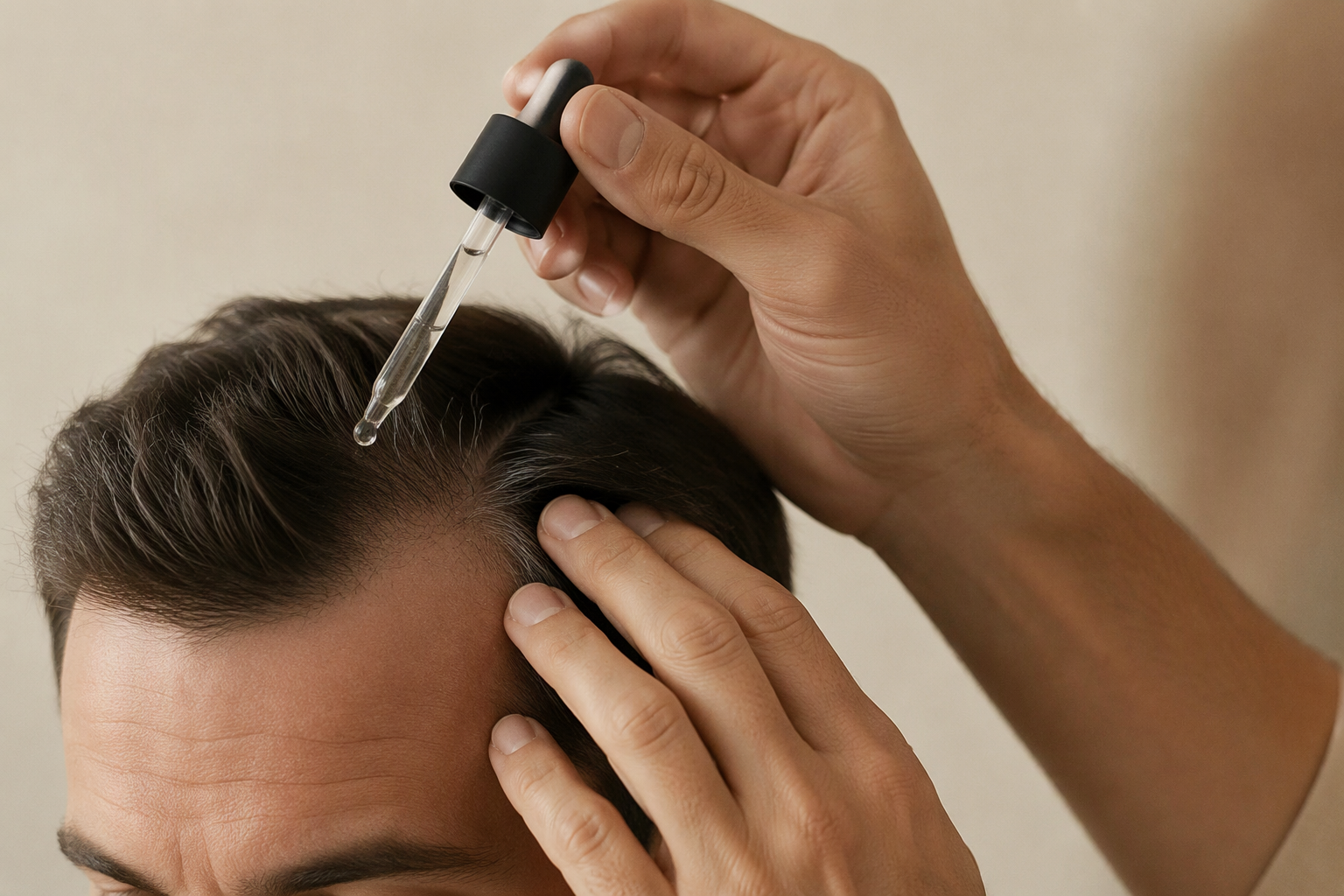
Minoxidil and finasteride are not interchangeable. Minoxidil supports follicle activity and the hair-growth cycle. Finasteride inhibits 5-alpha-reductase, reducing the conversion of testosterone to dihydrotestosterone, or DHT.
A clinician may prescribe them separately or together, depending on the diagnosis, eligibility, preferences, and risk tolerance. Neither medication is necessary for every patient.
Both have an established clinical role in androgenetic hair loss, but they create different safety and adherence questions. Topical minoxidil requires regular application and may irritate the scalp. Oral minoxidil involves off-label systemic use. Finasteride can be convenient as a tablet, but it requires informed discussion of sexual, mood, reproductive, and PSA-related considerations.
Benefits generally depend on continued treatment. Neither medicine should be presented as a permanent cure that can always be stopped after the preferred density appears.
Searches for hair-growth products without minoxidil often lead to supplements, oils, shampoos, and cosmetic thickening products. Some may support scalp care or improve appearance, but we would not present them as equivalent substitutes for medically appropriate treatment of androgenetic alopecia.
How Minoxidil Supports Hair Growth
Minoxidil may help support a longer growth phase and improve hair diameter or density in responsive follicles. Results vary, and treatment cannot revive every follicle or address every cause of hair loss.
Certain topical minoxidil products are FDA approved for specified hair-loss indications, formulations, and populations. Concentration, application instructions, and patient characteristics still matter.
Low-dose oral minoxidil is different. The tablet was developed and approved as an antihypertensive, while its use for hair loss is off label. Oral treatment may be appropriate for selected patients, but it creates systemic exposure and should not be marketed as merely a cleaner version of topical therapy.
Our guide to oral minoxidil’s benefits, risks, and realistic results provides a fuller comparison.
Does Finasteride Remove DHT?
No. Finasteride does not remove or eliminate DHT.
It inhibits 5-alpha-reductase, which reduces the conversion of testosterone to DHT. Lower DHT exposure may help slow androgen-driven follicle miniaturization in appropriately selected men with androgenetic alopecia.
Oral finasteride has an approved role in male pattern hair loss. That does not make an approved tablet equivalent to every topical compounded finasteride product.
A topical formula can still lead to systemic exposure. Its concentration, vehicle, application area, combination ingredients, and pharmacy preparation should all be considered.
When Combination Therapy May Make Sense
Combining minoxidil and finasteride can have a clear rationale because the medicines address different aspects of androgenetic hair loss. One supports follicle activity, while the other reduces a hormonal driver of miniaturization.
That does not mean everyone should start both at once. If a patient begins minoxidil, finasteride, a supplement, and a compounded booster on the same day, a new symptom may be difficult to attribute. It may also be harder to identify which component produced any benefit.
Staged treatment can help a clinician and patient assess:
- Tolerability
- Adverse effects
- Adherence barriers
- Individual treatment benefit
- The minimum sustainable regimen
For other patients, the expected benefits may support combination treatment from the start. Either choice should have a documented rationale rather than serving as a default upsell.
Topical vs. Oral Hair Loss Treatment Plans
Oral treatment can be convenient, but convenience does not prove that it offers better care. The appropriate route depends on health history, lifestyle, scalp tolerance, household considerations, and the ability to follow the routine.
Topical minoxidil may leave residue, affect styling, irritate the scalp, or be difficult to distribute over a large area. Some patients dislike waiting for a foam or solution to dry.
Oral medication can simplify the routine. It also creates systemic exposure, which calls for different screening, counseling, and monitoring.
A patient with a sensitive scalp who struggles to apply foam consistently may want to discuss an oral option. If that same person has cardiovascular disease, symptoms of low blood pressure, fluid retention, or interacting medication, screening becomes more important than convenience.
Household circumstances also count. Topical medication must be applied, dried, stored, and handled according to instructions, with care taken to avoid unintended transfer to other people or pets.
Topical Plans: Lower Systemic Exposure Does Not Mean No Risk
Topical treatment is intended to act at the application site, but “topical” does not mean risk-free. A formulation can cause irritation, itching, flaking, redness, or contact dermatitis.
Minoxidil may contribute to unwanted facial hair if it runs or is applied beyond the intended area. Technique affects tolerability, adherence, and practical results.
A topical plan should explain:
- How much to apply
- Where and how often to apply it
- Whether the scalp and hair should be dry
- How long it should dry
- When to wash the hands
- How to reduce transfer to skin, bedding, or other people
- What to do if irritation develops
Topical finasteride deserves the same scrutiny. Lower expected systemic exposure does not mean zero exposure. Compounded combinations should disclose their exact strengths and dispensing pharmacy.
Oral Plans: Convenience With Systemic Considerations
Before prescribing an oral medication, a clinician should review medical history, current medicines, baseline symptoms, and relevant contraindications. Depending on the drug, blood pressure, cardiovascular history, kidney function, fluid retention, reproductive concerns, or PSA screening may matter.
Patients should know how to reach the prescriber if they experience:
- Dizziness or faintness
- Ankle swelling or rapid fluid accumulation
- Palpitations or a faster heart rate
- Sexual symptoms
- Mood changes
- Persistent headaches
- Any other new or concerning symptom
A subscription that makes treatment easy to buy but difficult to discuss after delivery has solved the wrong problem. We consider clinician access part of treatment, not an optional service.
Oral Minoxidil 2.5 mg: Uses, Off-Label Status, and Side Effects
A 2.5 mg minoxidil tablet is not a universal hair-loss dose. It is one tablet strength that a clinician may use when making an individualized prescribing decision.
Oral minoxidil was developed and approved to treat high blood pressure. Its use for hair loss is off label.
Off-label prescribing is common in medicine and can be appropriate. It still calls for a patient-specific assessment, informed consent, and a monitoring plan. Patients should not start, split, combine, or adjust tablets without instructions from their prescriber.
For more detail, see our minoxidil pill treatment guide.
What Is a Minoxidil 2.5 mg Tablet Used For?
In its approved context, oral minoxidil is an antihypertensive medicine. Clinicians may also prescribe low-dose oral minoxidil off label to support hair growth in selected patients.
Seeing a 2.5 mg tablet on a plan page does not establish that the full tablet—or any portion of it—is suitable for a particular person. Dose selection may depend on:
- The condition being treated
- Patient characteristics
- Cardiovascular and blood-pressure history
- Kidney health or fluid-retention risk
- Other medicines
- Baseline symptoms
- Previous response
- Adverse effects
- Prescriber judgment
A responsible plan explains the proposed dose and rationale. Dosing should not be treated as a preference selected from a checkout menu.
Potential Oral Minoxidil Adverse Effects
Possible effects include:
- Unwanted body or facial hair
- Fluid retention
- Ankle swelling
- Dizziness or lightheadedness
- Headache
- Increased heart rate
- Palpitations
Systemic medicines may also carry less common but potentially serious risks. The American Hair Loss Association advises consumers to examine the safety, transparency, regulatory status, and oversight of compounded or telemedicine-supplied hair-loss medication.
Chest pain, fainting, severe breathing difficulty, or marked or rapidly worsening swelling requires urgent medical evaluation. Patients should also receive clear instructions for reporting non-emergency symptoms.
We do not think risk should be exaggerated, but it should not be hidden behind descriptions of oral minoxidil as a mess-free upgrade. A convenient tablet remains a systemic medication.
Screening and Monitoring Questions to Ask
Before accepting an oral minoxidil plan, we recommend asking:
- How is cardiovascular history assessed?
- Will baseline blood pressure or heart rate be reviewed?
- How are kidney problems and fluid retention considered?
- Which medicines or conditions could create concern?
- What baseline symptoms should be reported?
- What monitoring is required after treatment begins?
- Who reviews dizziness, swelling, headaches, or palpitations?
- How quickly can the prescriber be reached?
- Which symptoms require urgent medical care?
The answers will vary by patient, but every provider should have a defined process.
Finasteride Benefits, Side Effects, and Informed-Consent Questions
Finasteride may help appropriately selected men manage androgenetic alopecia by lowering DHT exposure. It is generally used as ongoing treatment rather than a cure, and benefits may diminish after discontinuation.
Patients deserve a balanced discussion. We would not dismiss finasteride because adverse effects are possible, nor would we minimize those concerns because many patients tolerate treatment.
Oral finasteride has approved labeling for male pattern hair loss in an appropriate population. Topical finasteride is different. Many online versions are compounded, may use different strengths and vehicles, and do not carry the same product-level approval as an FDA-approved finished tablet.
The comparison therefore involves more than topical versus oral administration. Exact dose, formulation, exposure, evidence, pharmacy controls, patient characteristics, and monitoring all matter.
Sexual, Mood, and Fertility Considerations
Reported sexual adverse effects include changes in libido, erectile function, and ejaculatory function. Persistent or concerning symptoms should be reported to the prescriber rather than managed through guesswork or anonymous advice.
Mood concerns also deserve direct discussion, particularly when a patient has a relevant history or notices a significant change after starting treatment. Fertility questions may require an individualized review based on symptoms, reproductive plans, and clinical circumstances.
Informed consent allows patients to weigh potential hair-preservation benefits against the risks and uncertainties that matter to them. One person may prioritize DHT reduction and accept those risks. Another may prefer to begin without finasteride.
Both preferences can be reasonable. Meaningful personalization records the preference and supports an informed decision instead of pushing everyone into the same bundle.
Pregnancy Handling and PSA Interpretation
People who are or may become pregnant should not handle crushed or broken finasteride tablets because of potential fetal risk. Tablets should be stored and handled according to the medication instructions and clinical advice.
Finasteride can also affect the interpretation of prostate-specific antigen, or PSA, results. Current or recent use should be disclosed to clinicians involved in prostate screening or evaluation.
These points may not appear prominently on a simple product page, but they are part of responsible prescribing.
Questions Before Starting Finasteride
We recommend asking:
- Does the hair-loss pattern fit androgenetic alopecia?
- What form and dose are being proposed?
- Why is oral or topical treatment preferred?
- Is the topical product compounded?
- What benefits are realistic?
- What alternatives are available?
- How will sexual, mood, or fertility concerns be handled?
- Could treatment affect PSA interpretation?
- Can this medication be changed independently of the bundle?
- Can the subscription be paused or canceled if treatment is unsuitable?
A plan should not force continued purchase of supplements, shampoo, or another medicine because one component has to be discontinued.
Supplements and Compounded Formulas: When More Is Not Better
A longer ingredient list can increase cost and uncertainty without improving care. Starting several products at once makes it harder to identify which one helped, caused an adverse effect, or added no value.
Supplements have a defensible role when they address a documented deficiency or specific clinical need. They should not automatically be treated as substitutes for therapies directed at androgen-driven follicle miniaturization.
We apply the same scrutiny to custom formulas. Compounding can be useful when a prescriber has a patient-specific reason for a particular ingredient, strength, or dosage form. The label “custom compounded” does not by itself establish better effectiveness, safety, stability, or consistency.
When a Supplement Has a Clinical Rationale
A patient’s history, symptoms, examination, or laboratory results may justify evaluation for:
- Iron deficiency
- Vitamin D deficiency
- Zinc deficiency
- Inadequate protein intake
- Thyroid disease
- Other nutritional or medical contributors
Correcting a confirmed deficiency may be important. It does not follow that every person with gradual pattern hair loss needs an indefinite supplement subscription.
Excess supplementation can be unnecessary and may cause harm. Ingredients can overlap across multivitamins, hair products, and separate supplements, raising the risk of excessive intake or interactions.
A deficiency-directed product also does not automatically address DHT-driven miniaturization. The diagnosed problem and proposed solution should match.
Compounded Does Not Automatically Mean Superior
FDA-approved finished products undergo product-specific review for their approved use. Off-label prescribing uses an approved drug outside its labeled indication, route, dose, or population based on clinical judgment.
Compounded medications are prepared for specific needs and are not the same as FDA-approved finished products. The American Hair Loss Association recommends close attention to regulatory distinctions, transparency, and potential inconsistencies when online providers offer compounded hair-loss medicines.
Before buying a compounded plan, we suggest requesting:
- Every active ingredient
- The exact strength of each ingredient
- The dosage form and application instructions
- The patient-specific reason for the combination
- The dispensing pharmacy’s identity
- Relevant sourcing and quality controls
- Available stability or beyond-use information
- Storage requirements
- Notice of supplier, ingredient, or formula changes
- The process for reporting problems
A compounded topical may be reasonable when a clinician can explain why that particular formula meets a patient’s needs. It should not be presumed stronger or safer because it contains more ingredients.
A Clearer Way to Evaluate Multi-Ingredient Plans
Every component needs a rationale. The plan should identify which diagnosed or suspected problem an ingredient targets and why it was selected.
It may also be reasonable to discuss introducing components sequentially. A staged approach can make benefits and tolerability easier to interpret, although the right sequence depends on clinical judgment and patient priorities.
Finally, we recommend asking whether the plan can be simplified. A smaller, sustainable regimen may be more practical than an elaborate formula that is used inconsistently.
True Cost, Refill Terms, Clinician Access, and Long-Term Fit
The advertised monthly price rarely reveals the full cost. Introductory discounts, multi-month shipments, required supplements, consultation charges, shipping, and automatic renewals can change what a patient actually pays.
Because continued treatment may be necessary to maintain benefits, affordability and adherence are clinical considerations as well as financial ones.
A plan that is manageable during a promotional period may become unrealistic later. We compare both initial and ongoing costs, along with the likely consequences of stopping treatment.
Calculate the Cost Actually Charged
A useful formula is:
Total cost = consultation + medication + testing + shipping + required add-ons + optional products, adjusted for refill frequency and post-introductory pricing.
For each plan, document:
- Initial consultation fee
- Follow-up charges
- Laboratory or testing costs
- Introductory medication price
- Regular refill price
- Quantity supplied per shipment
- Shipping and handling
- Required supplements or topical products
- Costs associated with dose or formula changes
- Minimum purchase or subscription term
A low first-shipment price can become more expensive when regular refills, clinician fees, add-ons, and cancellation deadlines are included.
Month-to-month flexibility may cost more per shipment but reduce commitment. Multi-month orders may lower the apparent monthly price while increasing the upfront charge and the risk of receiving medicine that is no longer suitable.
Read Refill and Cancellation Rules Before Checkout
We recommend checking:
- When the next order will process
- How early cancellation must be submitted
- Whether a pending shipment can be stopped
- Whether unused shipments are refundable
- Whether treatment can be paused
- Whether one medicine can be removed from a bundle
- Whether a prescription change alters the subscription term
- Whether renewal is automatic
- Whether records remain accessible after cancellation
Patients should also know what happens to clinician access, prescription management, and follow-up after a subscription ends. Canceling delivery should not create confusion about managing an active adverse effect.
Saving a copy of the checkout terms provides a record if policies or promotions later change.
Who Monitors the Plan?
The provider should identify the licensed prescriber and explain how patients communicate with the clinical team. A generic customer-support inbox is not a substitute for medical review.
Questions worth asking include:
- Who reviews the initial assessment?
- Is follow-up automatic or patient-initiated?
- How are progress photographs evaluated?
- What is the response pathway for adverse effects?
- Does the same clinician or care team review changes?
- Can the prescriber modify one component?
- Is referral available when the diagnosis is uncertain?
- How are urgent and non-urgent symptoms separated?
We consider clinician access and pharmacy transparency core measures of value. Automatic delivery is useful only when it supports appropriate, monitored care.
Timelines, Progress Tracking, and When to See a Dermatologist
Hair grows through slow biological cycles, so visible change usually takes time. Some patients may also notice a change in shedding after starting treatment.
Results depend on the diagnosis, duration of loss, follicle viability, adherence, treatment choice, and individual response. Daily mirror checks tend to magnify normal variation without creating a reliable record.
Female hair loss requires its own evaluation. Pregnancy potential, hormonal factors, iron status, thyroid disease, medicine eligibility, and the underlying diagnosis can all affect treatment decisions. A pill bundle designed around male pattern hair loss should not be generalized to women.
The treating clinician should define when progress will be reviewed and what would justify continuing, modifying, testing, or referring.
How to Document Progress Consistently
We recommend taking baseline photographs before treatment and repeating them at regular intervals under similar conditions:
- Lighting
- Camera and lens
- Angle
- Distance
- Hairstyle
- Hair length where practical
- Wet or dry condition
- Part placement
Images should include the temples, frontal hairline, top, crown, and any focal area of concern. A wet, brightly lit baseline cannot be compared fairly with a dry, styled follow-up.
It also helps to track:
- Missed applications or doses
- Formula or dosage changes
- Scalp symptoms
- Shedding changes
- Adverse effects
- New medicines or illnesses
- Relevant laboratory findings
- Major dietary or weight changes
This record gives the clinician more useful information than memory alone.
When a Plan Should Be Reassessed
A plan may need reassessment after the clinician-defined trial period when:
- There is no stabilization or improvement
- Adherence is inconsistent
- Application technique is unclear
- Adverse effects emerge
- The scalp becomes inflamed
- The pattern changes
- Cost becomes unsustainable
- A new condition or medicine changes the risk profile
We would not respond automatically by adding ingredients. Diagnosis, technique, consistency, tolerability, and alternative causes should come first.
Sometimes the right adjustment is a different route or medicine. Sometimes it is a simpler plan. In other cases, the appropriate next step is an in-person examination rather than another subscription product.
Red Flags That Need In-Person Evaluation
Prompt medical or dermatology evaluation is appropriate for:
- Sudden hair loss
- Distinct patches of loss
- Scalp pain or tenderness
- Marked redness or inflammation
- Pustules or drainage
- Heavy scaling
- Signs of infection
- Eyebrow or body-hair loss
- Smooth or shiny areas that may indicate scarring
- Loss of visible follicular openings
Severe medication symptoms—including chest pain, fainting, significant breathing difficulty, or rapidly worsening swelling—require urgent medical care.
Our standard is simple: treatment should be built around the person, not merely the subscription.
FAQ
What Are the Side Effects of Oral Minoxidil?
Possible effects include unwanted facial or body hair, ankle swelling, fluid retention, dizziness, headache, increased heart rate, and palpitations. Chest pain, fainting, breathing difficulty, or marked swelling warrants urgent medical evaluation rather than waiting for a routine subscription response.
Does Finasteride Remove DHT?
No. Finasteride inhibits 5-alpha-reductase and reduces the conversion of testosterone to DHT, but it does not eliminate DHT. That reduction may help slow androgen-driven follicle miniaturization in appropriately selected men.
What Is a Minoxidil 2.5 mg Tablet Used For?
Oral minoxidil is approved as an antihypertensive. Clinicians may also prescribe low doses off label for hair loss. A 2.5 mg tablet is a medication strength, not a universal hair-loss dose. Selection depends on health history, other medicines, response, adverse effects, and clinical judgment.
Are Customized Compounded Hair-Loss Formulas Better?
Not automatically. A compounded formula adds value when a prescriber has a patient-specific reason for its ingredients, strengths, and dosage form. We recommend asking for the exact formula, pharmacy identity, available quality information, and monitoring plan.
How Long Does Online Hair-Loss Treatment Take to Work?
Visible improvement generally takes months rather than days because of the hair-growth cycle. Timing varies with the diagnosis, treatment, duration of loss, follicle viability, and adherence. Standardized photographs and scheduled clinical reviews provide a better record than daily mirror checks.
Are Hair-Loss Supplements Worth Adding?
They may be useful when evaluation identifies a relevant deficiency or nutritional need. They should not be assumed to treat DHT-driven hair loss. Ingredient amounts, overlapping products, possible interactions, recurring cost, and the clinical reason for each supplement should all be reviewed.
Build a Hair Loss Plan Around Your Biology
Stop guessing and start with a plan built around biology, medical context, treatment preferences, and long-term fit. Explore rootsbyga.com to learn how our personalized genetic insights can support a more transparent approach to hair-loss care.
Roots by Genetic Arts
22 Oct 2026
Related Posts
-

Compare Leading Online Hair Loss Treatment Plans That May Include Minoxidil, Finasteride, Supplements, or Customized Treatment
Compare minoxidil, finasteride, supplements, costs, safety screening, and personalized care to find an online hair loss plan that fits your needs.
Read more -

The True-Personalization Audit: Compare Leading Online Hair Loss Treatment Plans That May Include Minoxidil, Finasteride, Supplements, or Customized Care
See how online hair loss plans compare on minoxidil, finasteride, supplements, safety screening, and truly customized care before you subscribe.
Read more -

The True-Personalization Audit for Hair Loss Treatment: Beyond Minoxidil, Finasteride, Supplements, and “Customized” Plans
See how leading online hair loss plans compare on diagnosis, ingredients, dosing, safety, and follow-up so you can spot real personalization. Read the audit.
Read more
Thanks for your order!
Login into your profile to set up your account.