
21 Nov 2026
Dustasteride for Hair Loss: Dutasteride Benefits, Risks, and Results
Learn why dustasteride is a misspelling of dutasteride, how the drug may affect hair loss, and which benefits and risks to discuss with a clinician.

Share


TL;DR
“Dustasteride” is a common misspelling of dutasteride, a prescription drug that lowers dihydrotestosterone (DHT). Clinicians may prescribe it off-label for androgenetic alopecia, but stronger DHT suppression is not automatically better. Its long persistence in the body, possible side effects, fertility considerations, and pregnancy precautions make diagnosis and medical oversight essential.
Table of Contents
- Dustasteride or dutasteride? Start with the correct medication
- How dutasteride blocks DHT and affects male pattern hair loss
- Dutasteride for hair loss: dosing and off-label status
- Dutasteride vs finasteride: efficacy, safety, and persistence
- How long does dutasteride take to work for hair loss?
- Dutasteride side effects, fertility concerns, and safety monitoring
- Oral vs topical dutasteride—and where combination treatment fits
- Who may—or may not—be a candidate for dutasteride
- Personalizing the decision: stop guessing, start growing
- FAQ
- Build a hair-loss plan around your biology
Dustasteride or dutasteride? Start with the correct medication
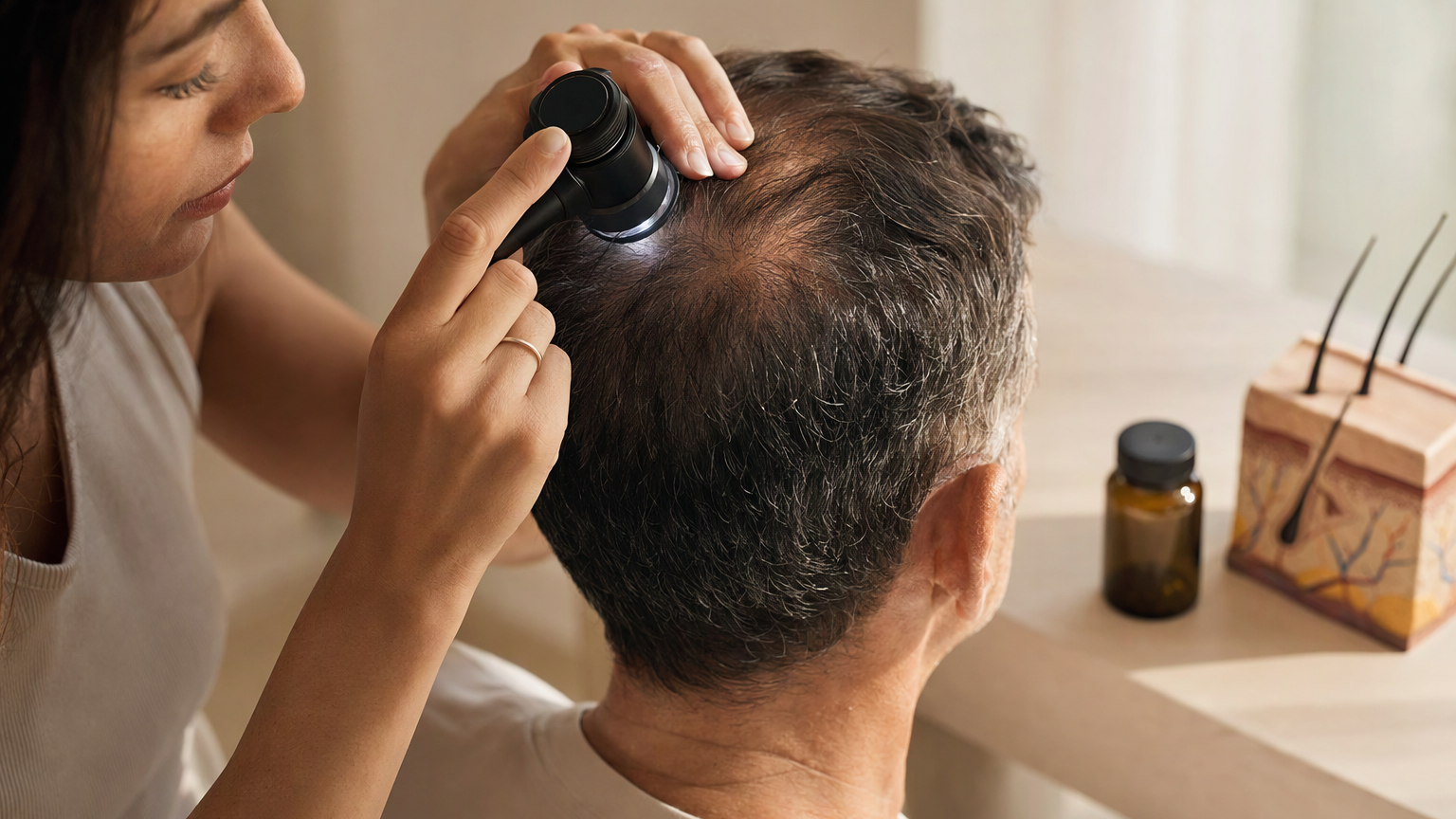
“Dustasteride” is a spelling error. The correct name is dutasteride, a prescription 5-alpha-reductase inhibitor approved in the US for benign prostatic hyperplasia.
Dutasteride reduces DHT, a hormone involved in follicle miniaturization in androgenetic alopecia. It may help slow this process, but it is not an instant growth treatment and will not address every cause of thinning.
Our view is simple: diagnosis comes before medication. Sudden shedding, patchy loss, scalp inflammation, scarring, or hair loss associated with another medical condition requires proper investigation. Our diagnosis-first guide to hair-loss drugs explains why the cause matters more than choosing the strongest drug.
What dutasteride is—and what it is not
Dutasteride may be considered when a clinician confirms androgenetic alopecia. It should not be treated as a universal solution for shedding or thinning.
A sound decision accounts for previous treatments, medical history, reproductive goals, possible adverse effects, and the drug’s long persistence in the body.
How dutasteride blocks DHT and affects male pattern hair loss
The 5-alpha-reductase enzyme converts testosterone into DHT. Dutasteride inhibits both major forms of this enzyme, while finasteride acts more selectively.
Lowering DHT aims to slow progressive follicle miniaturization. However, a larger reduction in circulating DHT does not guarantee a better visible result. Response also depends on:
- Genetics and age of onset
- Hair-loss pattern and progression
- Remaining follicle viability
- Treatment consistency
- Other therapies
- Individual biological response
Why more DHT suppression is not automatically better
Hair-loss treatment is a balance between potential benefit and tolerability. Broader, longer-lasting DHT suppression may be reasonable when loss continues despite an adequate treatment trial. It may add unnecessary risk or complexity for someone whose condition is already stable.
We recommend considering side-effect concerns, fertility plans, treatment simplicity, and willingness to continue medical follow-up—not just drug strength.
Dutasteride for hair loss: dosing and off-label status

Dutasteride has been studied and prescribed for androgenetic alopecia, but it is not FDA-approved for hair loss in the United States. A licensed clinician may still prescribe it off-label when appropriate.
Online discussions often focus on a particular dose or schedule. Repetition does not make that regimen suitable for everyone. Patients should not self-medicate, change doses, or create intermittent schedules from forum advice.
What off-label prescribing means
Off-label use means the proposed treatment is not included in the medication’s FDA-approved labeling. It does not automatically mean the treatment is unsafe or ineffective.
Responsible prescribing should include a discussion of the available evidence, uncertainty, alternatives, possible adverse effects, and monitoring.
Why a standard dose is not personalized care
Personalized care starts with confirming the diagnosis. A clinician should also review current medications, baseline symptoms, previous treatment response, fertility plans, and treatment goals.
At rootsbyga.com, we use genetic context as one part of that assessment. It supports clinical decision-making rather than replacing it.
Dutasteride vs finasteride: efficacy, safety, and persistence
Dutasteride inhibits more forms of 5-alpha-reductase and generally suppresses DHT more broadly. Finasteride is FDA-approved for male pattern hair loss, whereas dutasteride remains off-label for that use in the US.
Research suggests dutasteride may produce greater average improvement for some patients, but findings vary by study design and population. Neither medication guarantees regrowth, and average results cannot predict an individual outcome.
Dutasteride also remains in the body much longer than finasteride. That difference affects treatment changes, side-effect assessment, and reproductive planning.
When a finasteride switch may be premature
Hair grows slowly, so limited early regrowth does not necessarily mean finasteride has failed. Before discussing a switch, we recommend reviewing adherence, diagnosis, treatment duration, photographs, tolerability, and evidence of continued progression.
Our finasteride and minoxidil comparison provides more context on their different roles.
The practical meaning of a long half-life
Stopping dutasteride does not remove it from the body immediately. Its persistence can support sustained DHT suppression, but it also makes rapid treatment changes more difficult.
Intended and unwanted effects may take time to change after discontinuation. Patients should understand that trade-off before starting treatment.
How long does dutasteride take to work for hair loss?
Visible change usually takes months rather than weeks. Stabilization or reduced shedding may occur before improvements in density or hair caliber.
Temporary shedding can follow a treatment change, but severe, sudden, or persistent shedding needs clinical review. Benefits generally require continued therapy; androgenetic hair loss may resume after treatment stops.
Early treatment: establish a baseline
Record recession, density, shedding, symptoms, and concurrent treatments. Photographs should use consistent lighting, angles, distance, and hairstyle.
Daily mirror checks are poor evidence and often create unnecessary anxiety.
Mid-treatment: look for stabilization
Review adherence, side effects, shedding, and standardized images. An unchanged appearance may represent success if the hair loss was previously progressing.
If loss worsens, investigate the cause rather than automatically increasing treatment.
Longer-term review: evaluate response
Compare photographs with predefined goals. A clinician can then discuss continuation, adjustment, combination therapy, or further diagnostic testing.
Changing several treatments without documentation makes genuine response difficult to judge.
Dutasteride side effects, fertility concerns, and safety monitoring
Possible side effects include reduced libido, erectile difficulty, ejaculation changes, and lower semen volume. Changes in semen parameters are also possible, so fertility and preconception plans belong in the initial discussion.
Other reported concerns include breast tenderness or enlargement, testicular discomfort, and allergic reactions. Mood changes have been reported, although causality is not always clear. Severe anxiety, depression, or suicidal thoughts require prompt professional support.
Dutasteride can also lower PSA values and complicate prostate-screening interpretation. Patients should tell relevant clinicians and laboratories that they take it. Our pre-treatment risk-screening guide covers broader treatment considerations.
Pregnancy handling and blood-donation precautions
Dutasteride can be absorbed through the skin. Anyone who is pregnant or may become pregnant should not handle leaking capsules because of potential fetal harm.
Capsules should remain intact and should not be opened, crushed, or chewed. Blood-donation restrictions also apply during treatment and for a period after stopping; a clinician or the product labeling can provide current guidance.
When to contact a clinician
Contact a clinician about persistent sexual or reproductive symptoms, breast changes, testicular pain, significant mood changes, or other concerning effects.
Severe swelling, breathing difficulty, or another serious allergic reaction requires urgent care. Immediate mental-health risk requires emergency support rather than a routine follow-up.
Oral vs topical dutasteride—and where combination treatment fits
Oral dutasteride creates systemic exposure. Evidence for topical dutasteride is less established, and formulations are not standardized.
“Topical” does not mean free from systemic effects. Absorption may vary with the concentration, vehicle, application frequency, scalp condition, and procedures such as microneedling.
Dutasteride with minoxidil
Dutasteride targets DHT, while minoxidil supports hair growth through a different mechanism. A clinician may combine them when the expected benefit justifies the additional cost, complexity, and monitoring.
Starting several treatments at once makes it harder to identify which one caused an improvement, shedding change, or adverse effect.
Why topical does not mean risk-free
Before using topical dutasteride, patients should review the formulation source, evidence, absorption uncertainty, pregnancy precautions, and monitoring plan.
Different topical products cannot be assumed to deliver equivalent exposure or results. Marketing claims are not a substitute for clinical evidence.
Who may—or may not—be a candidate for dutasteride
A potential candidate generally has confirmed androgenetic alopecia, ongoing progression, realistic expectations, and willingness to accept off-label treatment and follow-up. Previous finasteride use, response, adherence, and tolerability should inform the decision.
Closer review may be needed for people with liver disease, possible drug interactions, fertility plans, baseline sexual symptoms, a mood-disorder history, PSA monitoring, or planned blood donation. Women who are or may become pregnant must avoid dutasteride exposure.
Questions a responsible assessment should cover
- What type and stage of hair loss is present?
- Have first-line treatments received an adequate trial?
- Is the goal stabilization, regrowth, simplicity, or lower systemic exposure?
- Are fertility or pregnancy considerations relevant?
- Would another treatment offer a better balance of benefit and risk?
Personalizing the decision: stop guessing, start growing
A responsible plan considers family history, age of onset, loss pattern, progression, medical history, previous response, goals, and risk tolerance. Genetic insights can provide context, but they cannot guarantee response or eliminate side-effect risk.
We recommend documenting baseline photographs, symptoms, shedding patterns, medications, and treatment timelines. Follow-up should occur at planned checkpoints rather than after every difficult mirror check.
What to bring to a hair-loss consultation
Bring:
- A timeline of onset and progression
- Family history and representative photographs
- Previous treatment details and side effects
- Current medications, supplements, and health conditions
- Relevant laboratory or PSA history
- Fertility goals and a definition of treatment success
What responsible genetic personalization can—and cannot—do
Genetics can complement diagnosis, family history, clinical pattern, and previous treatment response. It cannot prove that dutasteride is the correct choice or predict certain regrowth.
This article provides general medical information, not individual medical advice. Consult a qualified clinician before starting, stopping, or changing prescription treatment.
FAQ
Is Dustasteride the same as dutasteride?
“Dustasteride” is a common misspelling. Dutasteride is the correct name of the prescription medication.
Is dutasteride stronger than finasteride for hair loss?
Dutasteride suppresses DHT more broadly, but that does not guarantee a better individual result. Safety, treatment history, fertility plans, and personal priorities also matter.
How long does dutasteride take to produce results?
Hair changes usually take months. Stabilization may appear before visible improvements in density, so we recommend standardized photographs and clinician-led follow-up.
What happens after stopping dutasteride?
Dutasteride leaves the body slowly. Its effects may therefore take time to change, and maintained hair benefits may gradually diminish as androgenetic hair loss resumes.
Is topical dutasteride safer than oral dutasteride?
Not automatically. Systemic absorption may still occur, formulations vary, and the evidence is less established. Product quality and monitoring remain important.
Build a hair-loss plan around your biology
Explore a personalized hair-loss assessment with rootsbyga.com to review your diagnosis, treatment history, genetic context, goals, and acceptable trade-offs before deciding whether dutasteride belongs in your plan.
Roots by Genetic Arts
21 Nov 2026
Thanks for your order!
Login into your profile to set up your account.