What Side Effects Should I Consider Before Starting a Personalized Topical or Oral Hair Loss Treatment?

TL;DR

“What side effects should I consider before starting a personalized topical or oral hair loss treatment?” is a question best answered with a clinician who knows the exact ingredients, dose, formulation, health history, and other medications involved. We recommend discussing possible scalp reactions, blood-pressure or heart-rate changes, sexual or mood symptoms, fertility plans, medication interactions, and follow-up before the first dose. Topical treatment is not risk-free, and oral treatment is not automatically unsuitable. Seek immediate medical care for chest pain, fainting, severe swelling, breathing difficulty, or signs of a serious allergic reaction.

Table of Contents

What side effects should you consider before starting a personalized topical or oral hair loss treatment?

What side effects should you consider before starting a personalized topical or oral hair loss treatment?

Before treatment, we recommend reviewing possible local reactions, broader physical effects, sexual or mood changes, fertility goals, drug interactions, and the monitoring plan. The relevant risks depend on the active ingredient and the person using it—not simply whether the medication is topical or oral.

Dose, formulation, application habits, existing symptoms, medical history, and other treatments can all affect tolerability. A useful plan should also explain how to respond if symptoms appear:

  • Monitor mild effects that the prescribing clinician has identified as expected.
  • Contact the clinician about persistent, worsening, or concerning changes.
  • Seek urgent care for chest pain, fainting, breathing difficulty, severe swelling, or signs of a serious allergic reaction.

This article supports an informed clinical discussion. It cannot diagnose a reaction or determine whether someone should start, stop, or change a prescription.

Questions to answer before the first dose

We suggest asking:

  1. What active ingredients and doses are included?
  2. Which existing symptoms should be documented?
  3. Could any health condition affect treatment suitability?
  4. Could prescriptions, supplements, or over-the-counter products interact with it?
  5. Which symptoms require monitoring, prompt contact, or emergency care?
  6. When will treatment be reviewed?

Recording existing scalp irritation, shedding, mood, sexual function, blood pressure, or other relevant symptoms can make later changes easier to assess.

Topical versus oral treatment: is topical hair-loss treatment always safer?

Not necessarily. The route changes the type and degree of exposure, but it does not settle the safety question by itself. Topical products may still cause local reactions and may be absorbed beyond the application area. Oral products create systemic exposure and can require a different level of screening or monitoring.

Possible topical concerns include itching, redness, flaking, residue, unwanted hair outside the treatment area, accidental transfer, and inconsistent application. Oral treatment avoids scalp application but may introduce effects elsewhere in the body, depending on the medication.

Practicality matters too. A formula that is irritating, difficult to apply, or frequently forgotten may not be a sustainable choice. In our view, the goal is not to select the weakest or most convenient option. It is to find an appropriate regimen that can be used consistently under clinical supervision.

Factors that may affect topical exposure

A prescriber may consider:

  • The amount and frequency applied
  • The size and condition of the treatment area
  • Scalp inflammation, damage, or sensitivity
  • The ingredient concentration and formulation base
  • Accidental spread to the face, surfaces, or other people
  • The use of multiple ingredients in one formula

If irritation begins after starting a compounded treatment, the active medication may not be the only possible cause. The formulation vehicle or another ingredient may also need review.

When an oral option may be considered

An oral option may be discussed when scalp intolerance or the burden of regular application makes topical treatment impractical. Convenience alone does not establish that it is suitable.

Before considering oral treatment, we recommend disclosing cardiovascular or kidney conditions, blood-pressure concerns, fainting, swelling, and all current medications. The clinician can then assess possible overlapping effects and decide what monitoring is appropriate.

Minoxidil side effects: what changes between topical and oral use?

Minoxidil side effects: what changes between topical and oral use?

Topical and oral minoxidil use the same active ingredient through different routes. Their likely effects and monitoring needs are not identical, so the prescriber should explain the specific risks of the recommended product.

Our guides cover additional considerations around oral minoxidil for hair growth and using a minoxidil pill for hair loss. We advise following the prescribed dose and never compensating for a missed dose or application unless instructed to do so.

Topical minoxidil side effects

Product information and clinicians may warn about effects such as:

  • Itching, dryness, flaking, or redness
  • Scalp irritation or contact dermatitis
  • Unwanted hair where the product spreads
  • Changes in shedding
  • Symptoms such as dizziness, swelling, or palpitations

Scalp symptoms may come from minoxidil, the formulation base, or another ingredient. Rather than switching products repeatedly, contact the prescriber so the likely cause can be reviewed.

Oral minoxidil side effects

Oral minoxidil may be associated with unwanted facial or body hair, fluid retention, headache, lightheadedness, blood-pressure changes, or a faster heart rate. Individual suitability depends on medical history, dose, and interacting treatments.

New swelling, marked dizziness, a racing heartbeat, or shortness of breath should be reported promptly. Chest pain, fainting, severe swelling, or breathing difficulty requires urgent assessment.

Finasteride and dutasteride side effects: sexual health, mood, fertility, and PSA

Before using finasteride or dutasteride, ask the prescriber to review possible sexual, breast, mood, and fertility-related effects listed for the specific product. A symptom that appears during treatment deserves attention, although timing alone does not prove that a medication caused it.

Documenting baseline sexual function, mood, breast symptoms, and fertility plans can support a more useful follow-up. Finasteride use should also be disclosed to clinicians involved in prostate-specific antigen, or PSA, testing because it may affect how results are interpreted.

Topical finasteride can still be absorbed, while oral finasteride and dutasteride require their own risk discussions. For a closer medication comparison, review our guide to dutasteride versus finasteride.

Discussing sexual and mood symptoms

We recommend reporting meaningful sexual or mood changes rather than dismissing them or assuming their cause. Stress, existing conditions, other medications, and expectations may complicate the assessment.

A clinician can consider symptom timing, severity, alternative explanations, and whether treatment should be adjusted. Repeatedly stopping and restarting a prescription without guidance can make that assessment harder.

Fertility, pregnancy precautions, and PSA testing

Fertility goals should be discussed before treatment, particularly when there are existing concerns or difficulty conceiving. The clinician can advise whether evaluation, monitoring, or another approach is appropriate.

Follow the prescriber’s and dispensing pharmacy’s handling instructions, including pregnancy-related precautions for the specific product. Anyone undergoing PSA testing should disclose current or previous finasteride use.

Is early shedding expected—or a sign the treatment is not right for you?

Changes in shedding may occur after treatment begins, but they should not automatically be labelled normal. Timing, severity, distribution, scalp symptoms, illness, stress, nutrition, and other medication changes may all be relevant.

We suggest taking photographs under similar lighting, angles, hair length, and styling conditions. Consistent images are generally more useful for a clinical review than day-to-day impressions.

Patchy loss, scalp pain, inflammation, possible scarring, rapidly worsening loss, or other physical symptoms should prompt reassessment.

Monitor, message, or seek care?

  • Monitor: Mild changes that fit the expectations and timeline provided by the clinician.
  • Message the clinician: Persistent, severe, patchy, or rapidly worsening shedding, especially with irritation.
  • Seek urgent care: Hair or scalp changes accompanied by breathing difficulty, fainting, chest pain, facial swelling, or another severe reaction.

Which health conditions and medications should be reviewed first?

Provide a complete list of prescriptions, supplements, over-the-counter products, and other hair-loss treatments. Blood-pressure medicines, erectile-dysfunction drugs, and therapies with overlapping effects deserve particular review.

Also disclose cardiovascular, kidney, liver, blood-pressure, fainting, swelling, scalp, mood, sexual-health, breast, or fertility concerns. A genetic result may add context, but we do not view it as a substitute for medical history, examination, interaction checks, or contraindication screening.

Never use another person’s prescription or combine treatments without prescriber approval.

A pre-treatment checklist

Bring or document:

  • Current medications, supplements, allergies, and previous reactions
  • Relevant blood-pressure readings, if available
  • Medical conditions and fainting or swelling history
  • Baseline mood and sexual function
  • Fertility goals
  • Scalp symptoms and previous diagnoses
  • Consistent scalp photographs
  • Results and reactions from earlier treatments

How monitoring and adjustments can improve treatment tolerability

We view personalization as an ongoing process built around medical history, examination, treatment goals, and follow-up—not a one-time product selection. At rootsbyga.com, genetic information can inform that process, but it should not replace clinical screening.

Depending on the regimen, monitoring may include symptoms, blood pressure, heart rate, scalp photographs, or clinician-directed testing. Adjustments might involve dose, frequency, application technique, formulation vehicle, route, or medication choice.

Combination formulas can be convenient, but a reaction may be harder to trace when several ingredients begin at once. Where appropriate, a clinician may use controlled changes to identify the likely cause. Do not split, reduce, stop, or otherwise alter a prescription without instructions.

Establishing a baseline

Record relevant symptoms before treatment and agree on a follow-up plan. That plan should explain which changes can wait for routine review and which require earlier contact.

If the first plan is unsuitable

One poorly tolerated ingredient, dose, or formulation does not mean every treatment option is unsuitable. A clinician may consider an adjustment, substitution, route change, or discontinuation based on the reaction and treatment goals.

FAQ

Are topical treatments free from systemic side effects?

No. Absorption and broader reactions may still occur. Dose, concentration, application area, scalp condition, and formulation can affect exposure.

Should I stop treatment when I notice a side effect?

For nonurgent symptoms, contact the prescriber for instructions. Seek immediate care for chest pain, fainting, breathing difficulty, severe swelling, or a serious allergic reaction.

Are online side-effect stories reliable?

They may describe genuine experiences, but they cannot establish cause or predict another person’s response. We recommend using them to shape questions for a clinician, not to replace medical assessment.

Which symptoms need prompt attention?

Report marked dizziness, new swelling, persistent palpitations, significant sexual or mood changes, or worsening scalp symptoms promptly. Severe cardiovascular or allergic symptoms require urgent care.

Will progress disappear if treatment stops?

Results after discontinuation vary by medication and individual. Before stopping, ask the clinician what changes may occur and whether another suitable plan is available.

Build a safer personalized treatment plan

Explore rootsbyga.com to learn how our genetic insights, medical screening, and ongoing treatment review can support a personalized hair-loss plan.
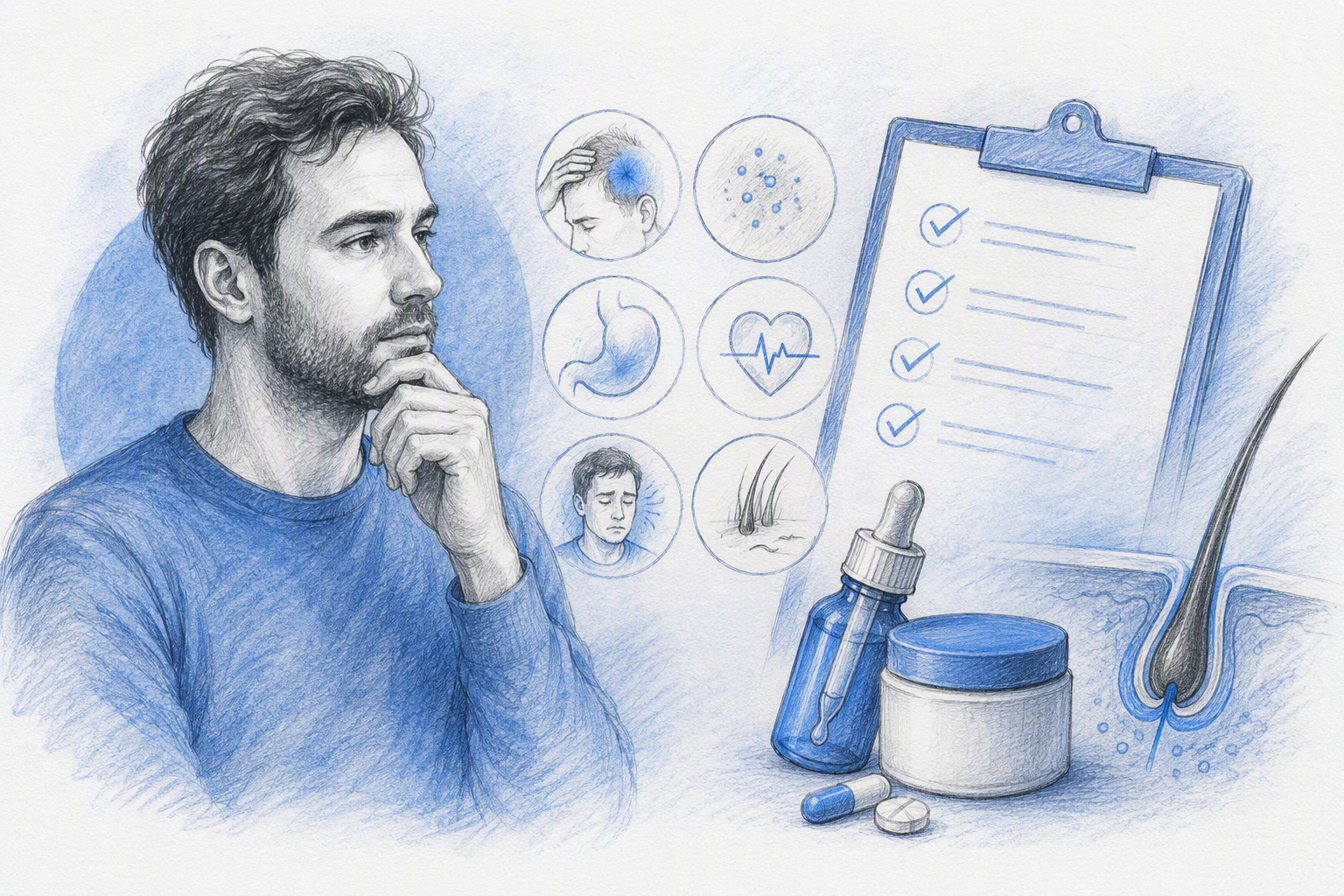

Pre-Treatment Risk Screening: What Side Effects Should I Consider Before Starting a Personalized Topical or Oral Hair Loss Treatment?

TL;DR

What side effects should I consider before starting a personalized topical or oral hair loss treatment? The answer depends on the ingredients, route, health history, medications, scalp condition, and reproductive goals involved. Before treatment, we recommend documenting a relevant baseline, reviewing possible interactions with a qualified clinician, and agreeing on follow-up and warning signs. Personalization cannot remove every risk, but it can replace guesswork with a clearer, more informed plan.

Table of Contents

Hair Loss Treatment Checklist Before Your First Dose

Hair Loss Treatment Checklist Before Your First Dose

This checklist complements our guide to what side effects to consider before starting personalized topical or oral hair-loss treatment. Here, we focus on screening and monitoring before treatment begins.

No questionnaire, genetic report, or clinical assessment can guarantee whether a reaction will occur. Pre-treatment screening helps identify concerns; it does not eliminate risk.

We recommend four steps:

  1. Review health history, medications, supplements, and treatment priorities.
  2. Document relevant symptoms and baseline measurements.
  3. Select the simplest suitable starting plan with a clinician.
  4. Define follow-up timing, warning signs, and escalation steps.

Stop Guessing and Establish a Baseline

Once treatment starts, it can be difficult to remember whether dizziness, shedding, scalp irritation, mood changes, or sexual symptoms were already present.

Record only what is relevant to the proposed treatment. A clinician may suggest blood pressure, pulse, scalp photographs, current shedding, existing symptoms, or scalp condition. This should be a practical reference point, not a daily surveillance project.

What Personalized Hair Loss Treatment Should Mean

A personalized plan may adjust the active ingredient, topical or oral route, dose or concentration, formulation, application area, schedule, and monitoring plan.

Those choices should reflect health history, treatment goals, risk tolerance, convenience, and the ability to follow the plan consistently. A pre-consultation case file based on symptoms, health history, and likely causes may provide better context than a generic questionnaire.

More ingredients do not automatically mean better personalization. Sometimes the more appropriate choice is a simpler formula.

What Genetic Insights Can and Cannot Tell Us

At rootsbyga.com, we treat genetic insights as one source of decision support. They do not replace medical history, clinical judgment, treatment goals, or follow-up.

A genetic report cannot guarantee effectiveness or predict every adverse reaction. We do not view it as a promise of side-effect-free treatment.

Why a Simple Starting Plan Can Help

Introducing fewer variables may make benefits and unwanted changes easier to interpret. When several active ingredients start together, identifying the responsible ingredient can be difficult.

Combination treatment may still be appropriate. If a clinician recommends it, every ingredient should be documented and included in the monitoring discussion.

Health History Details That May Affect Treatment

Health History Details That May Affect Treatment

A consultation should consider the individual rather than recite a generic list of adverse effects. Relevant details may include cardiovascular conditions, low blood pressure, fainting, swelling, kidney concerns, allergies, scalp disease, mental health, sexual health, fertility goals, and reproductive plans.

Mention conditions even if they seem unrelated to hair. Their relevance depends on the proposed ingredient, route, dose, and wider clinical context.

Cardiovascular and Blood Pressure Questions

Tell the clinician about dizziness when standing, palpitations, fainting, chest symptoms, unexplained swelling, low blood pressure, or a diagnosed heart condition.

These details warrant discussion when systemic exposure is possible. For example, a clinician may want baseline readings before considering oral minoxidil. Our guide to oral minoxidil effectiveness, dosage, side effects, and safety can help prepare questions, but it does not replace medical advice.

Mental Health, Sexual Health, and Fertility Goals

Discuss existing mood or sexual symptoms before treatment. A baseline makes later changes easier to describe without assuming that treatment caused them.

Fertility goals, pregnancy, breastfeeding, and reproductive plans should be raised before a prescription or compounded formula is finalized.

Scalp Health and Skin-Barrier Condition

Dermatitis, cuts, sunburn, inflammation, or recent scalp procedures may affect topical tolerability. Show the clinician any active scalp problem and ask whether it should be addressed before application begins.

Bring a Complete Medication and Supplement List

Include prescriptions, over-the-counter medicines, vitamins, herbal supplements, pre-workout products, topical medicines, and recreational substances when clinically relevant.

A clinician or pharmacist may need to review products that affect blood pressure, circulation, pulse, or fluid balance. Do not assume that a low dose removes the possibility of an interaction.

What to Record for Every Product

For each product, note its name, ingredients, strength, schedule, purpose, and how long it has been used. Include topical products and supplements rather than deciding in advance that they are irrelevant.

Do Not Change Existing Medication Yourself

Do not stop, skip, or alter prescribed medication to accommodate hair-loss treatment. Discuss whether the hair-loss plan should use a different ingredient, route, dose, formulation, or schedule instead.

Baseline Measurements for More Useful Follow-Up

Monitoring should match the proposed treatment and personal health history. Not everyone needs every measurement.

Objective Baseline Data

A clinician may recommend blood pressure, pulse, standardized scalp photographs, or a record of existing swelling. Follow the measurement instructions provided; readings taken under inconsistent conditions may be difficult to compare.

A Private Symptom Baseline

Briefly record existing dizziness, headaches, mood or sexual symptoms, scalp irritation, shedding, and palpitations when relevant. This record can support a more precise clinical conversation, but it cannot prove what caused a later symptom.

Consistent Progress Photography

Photograph the same scalp areas with similar lighting, angles, parting, hair condition, and styling. Compare images at planned intervals rather than reacting to small day-to-day differences.

Topical Treatment Does Not Guarantee Zero Systemic Exposure

Topical treatment is applied locally, but that does not guarantee that exposure remains entirely local. Absorption may depend on the formulation, concentration, amount, treatment area, application frequency, skin condition, and technique.

Oral treatment is not automatically unsuitable, and topical treatment is not automatically risk-free. Route selection should consider health factors, preferences, convenience, and likely adherence.

Factors That May Affect Topical Absorption

Using more than directed, applying over a larger area, treating broken or inflamed skin, or increasing application frequency may change exposure or irritation.

Do not compensate for a missed application with extra product unless the prescriber specifically directs it.

Questions to Ask About the Formulation

Ask for the active ingredients, concentrations, application amount, treatment area, drying instructions, hand-washing guidance, and missed-dose instructions.

For a compounded formula, confirm every active ingredient. If several are included, ask how the plan would be adjusted if a problem developed.

Choose a Start Plan That Is Easier to Interpret

A clinician-guided stepwise start may reduce uncertainty when several treatments are being considered. Dose, route, and formulation can sometimes be adjusted, but changes should come from the prescriber rather than improvised dosing.

Single-Active Versus Combination Formulas

A single-active formula has fewer variables. A combination formula may be convenient and clinically appropriate for some people.

Neither is universally superior. We recommend asking why each component is included and how the formula would be modified if tolerability became a concern.

Write Down the Exact Start Plan

Record the start date, dose or application amount, frequency, treatment area, planned titration, and missed-dose instructions. Keep this information accessible so the clinician can assess what was actually used if symptoms appear.

Agree on Monitoring and Escalation Before Treatment

Before starting, clarify which changes can be monitored, which require a call, and which warrant urgent care.

  • Monitor: Mild changes that the clinician has already discussed.
  • Contact the prescriber: Persistent, worsening, distressing, or function-limiting symptoms.
  • Seek urgent medical care: Chest pain, fainting, breathing difficulty, serious allergic symptoms, severe dizziness, significant swelling, a rapid or irregular heartbeat, or concerning mood changes.

Set Follow-Up Timing in Advance

Ask when the first check-in should occur, whether home measurements are needed, and whom to contact if symptoms develop. Useful details may include timing, severity, dose, application area, medication changes, requested readings, and photographs of visible reactions.

Know What Should Not Be Pushed Through

A new symptom does not prove that treatment is working. Cardiovascular, allergic, severe, sexual, or mood-related symptoms deserve clinical review rather than reassurance from social media.

Early Shedding Versus a Possible Adverse Reaction

Some treatments may be associated with changes in shedding, but that should not become a blanket explanation for every symptom or worsening pattern.

If the distinction is unclear, contact the clinician instead of self-diagnosing or abruptly changing treatment. Our comprehensive topical and oral treatment side-effect guide provides further ingredient- and route-specific context.

Questions to Ask Your Clinician Before Treatment

A useful consultation should explain why the ingredient, route, dose, and formulation fit the individual’s history and priorities.

The Pre-Start Consultation Checklist

  • What exactly is personalized in this plan?
  • Could any condition, medicine, supplement, allergy, or reproductive goal change the recommendation?
  • Why is this route appropriate?
  • Which baseline measurements should be collected?
  • What are the dosing and missed-dose instructions?
  • Which changes require a call or urgent care?
  • When will tolerability and effectiveness be reviewed?
  • How can the plan be adjusted if it is ineffective or poorly tolerated?
  • If this is a combination formula, how would a problem ingredient be identified?

FAQ

What should I check before starting hair-loss treatment?

Review medical history, medications, supplements, scalp condition, treatment goals, allergies, and reproductive considerations. A clinician can determine which baseline measurements are relevant.

Does topical hair-loss treatment stay completely local?

Not necessarily. Exposure may vary with the formulation, amount, treatment area, scalp condition, and application technique. Use the product only as directed.

Does shedding mean treatment is working?

Not automatically. Document its timing and pattern, then ask the prescribing clinician whether it fits the expected response. Do not use shedding to dismiss other symptoms.

Should I start several hair-loss ingredients at once?

Only when the prescribing clinician considers the combination appropriate. Starting several ingredients together can make benefits and adverse effects harder to attribute.

When should I contact a clinician about side effects?

Contact the prescriber about persistent, worsening, distressing, or function-limiting symptoms. Seek urgent care for severe or potentially dangerous symptoms, including breathing difficulty, chest pain, fainting, or signs of a serious allergic reaction.

Build Your Pre-Treatment Plan

Explore our genetics-informed approach at rootsbyga.com, then take your health history, medication list, baseline notes, and treatment questions to a qualified clinician before starting topical or oral hair-loss treatment.

Resume Subscription

Your subscription is on hold because the last payment failed.
Would you like to renew your subscription and process the payment now?